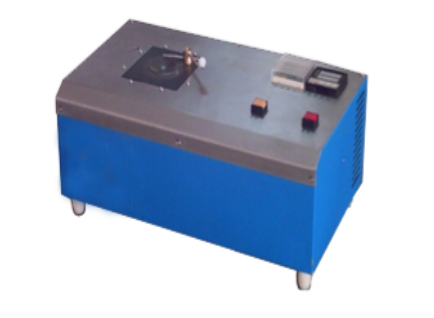
Sustained Combustion Tester
Category:Flammability Tester
Introduction
The Sustained Combustion Tester is designed to determine whether a material can continue to burn when heated and exposed to a flame under controlled conditions. The instrument uses a metal block with a recessed sample well, which is heated to a predetermined temperature. A specific amount of sample is placed in the well, and a standard flame is applied according to test requirements. After flame removal, the material is observed to assess whether sustained combustion occurs.
This test complies with the United Nations “Recommendations on the Transport of Dangerous Goods—Manual of Tests and Criteria,” 4th Revised Edition, and GB/T 21622 “Test Methods for Sustained Combustion of Flammable Liquids.” It is suitable for liquids with flash points not exceeding 60.5 °C in closed-cup tests or 65.5 °C in open-cup tests.
Applications
(1) Testing the sustained combustion behavior of flammable liquids under controlled laboratory conditions.
(2) Evaluating safety of hazardous liquids in transport, storage, and handling scenarios.
(3) Assessing compliance of chemicals with international transport regulations.
(4) Research and development of chemical formulations with reduced flammability risk.
(5) Quality control in chemical and petrochemical industries to prevent fire hazards.
Standards
(1) UN Recommendations on the Transport of Dangerous Goods, Manual of Tests and Criteria, 4th Revised Edition
(2) GB/T 21622: Test Methods for Sustained Combustion of Flammable Liquids (China)
(3) ISO 2592: Determination of Flash and Fire Points—Applicable for Reference in Flammable Liquids Testing
(4) ASTM D4206: Standard Test Method for Sustained Combustion of Flammable Liquids
Product Features
(1) Precision-controlled heating plate with integrated temperature control unit.
(2) Recessed sample well for uniform sample heating.
(3) Adjustable flame application with exact height and width specifications.
(4) Digital temperature monitoring using K-type thermocouples with ±0.1 °C accuracy.
(5) Use of propane or butane as test fuel.
(6) Syringe-based sample dosing for precise 2 ml measurements.
(7) Observational testing procedure to determine sustained vs. non-sustained combustion.
(8) Compliance with international and national flammability test standards.
Technical Parameters
| Parameter | Specification |
|---|---|
| Heating Plate Power | 1000 W |
| Test Temperature | 60.5 °C or 75 °C |
| Temperature Control | K-type thermocouple, ±0.1 °C |
| Flame Height | 8–9 mm |
| Flame Width | 5 mm |
| Burner-to-Sample Distance | 2.2 mm |
| Sample Volume | 2 ml (±0.1 ml) |
| Fuel Type | Propane or Butane |