Applications of Airflow Resistance Testers
Blog 4 1 月, 2026
What is an Airflow Resistance Tester
An airflow resistance tester is an instrument used to measure the resistance of materials or devices to airflow.
It quantifies the resistance encountered by gas as it passes through a specimen by controlling airflow and measuring the relationship between air pressure and flow rate, and then outputs a resistance value.
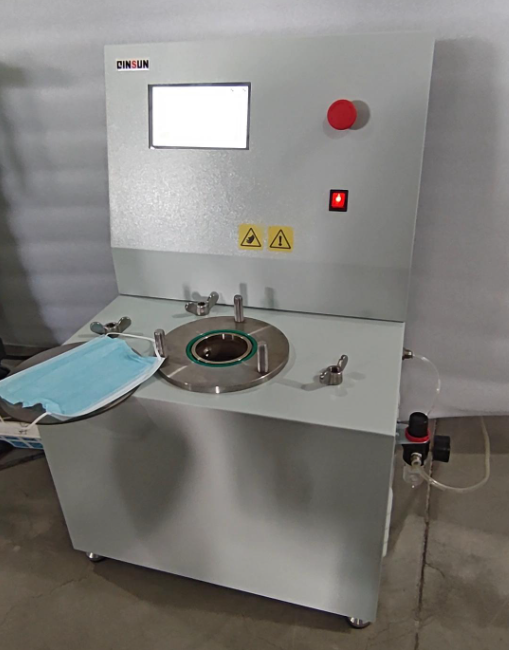
Depending on the test object, it may also be referred to as:
Medical Breathing Circuit Airflow Resistance Tester
Textile / Mask Airflow Resistance Tester
Airflow resistance measurement module in nasal oxygen cannula performance testers
Main functions:
Control airflow velocity and pressure
Accurately measure the pressure difference before and after the specimen
Calculate and output the “airflow resistance value”
Most instruments are equipped with data storage, printing, and report output functions
Applications of Airflow Resistance Testers
Airflow resistance testers are widely used in both laboratories and production processes, mainly including:
(1) Medical device testing
Testing the airflow resistance performance of breathing circuits used in anesthesia machines and ventilators, for medical quality control and inspection institutions.
Airflow resistance testing of nasal oxygen cannulas to ensure that the resistance of respiratory assistive devices meets specifications and usage requirements.
(2) Textile and protective equipment testing
Air permeability testing of textiles, cotton materials, and medical fabrics.
Breathing resistance and protective efficiency testing of masks, which is one of the important indicators for protection level evaluation (in combination with filtration efficiency testing).
(3) Scientific research and quality R&D
In material science, evaluating the airflow resistance and permeability of porous materials and filter media (such as foams, fibers, and fabrics).
Standards for Airflow Resistance Testers
Different test objects correspond to different standards. Common standards include:
Medical tubing and equipment
YY/T 0461-2003 Breathing Circuits for Anesthetic Machines and Ventilators, Appendix A (Airflow Resistance Measurement) and Appendix E (Bending Airflow Resistance Test).
Textiles and masks
GB 19083-2010 Technical Requirements for Medical Protective Masks — airflow resistance requirements.
YY 0469 / YY 0969 medical mask standards, which also involve breathing resistance indicators.
National and industry standards usually specify detailed requirements for airflow and resistance ranges, number of specimens, and test environmental conditions.
Note: For respiratory protective equipment (such as respirators), there are also dedicated resistance calibration specifications, for example, calibration specifications for breathing resistance testing instruments.
Working Principle of an Airflow Resistance Tester
The core physical concept of airflow resistance testing is:
When air passes through the test specimen, pressure loss occurs due to impedance effects. The relationship between this pressure difference and the airflow rate is used to represent resistance performance.
Basic principle steps:
Establish a stable airflow: generate a stable and controllable airflow rate or pressure through an air source.
Measure pressure difference: use high-precision pressure sensors to measure the pressure difference (ΔP) at the inlet and outlet of the specimen.
Calculate resistance: obtain the resistance index based on the pressure difference and airflow rate through formulas or built-in instrument algorithms.
Typical measurement parameters:
Flow rate (L/min or m³/h)
Pressure difference (Pa or kPa)
Resistance value (which may be normalized based on flow rate and pressure difference)
For example, in breathing circuit testing, the resistance value can be calculated by recording the pressure difference before and after the specimen after adjusting the air source pressure and flow rate.
Operating Method of an Airflow Resistance Tester
The following is a typical laboratory operating procedure (taking breathing circuits / nasal oxygen cannulas as an example):
(1) Preparation
Ensure the power supply voltage is correct (usually AC 220V).
The instrument warm-up time is generally no less than 15–30 minutes to ensure sensor stability.
Check that all connecting pipelines are free from leakage.
(2) Test parameter setting
Select the “airflow resistance test mode” on the main control interface.
Set the test airflow rate and pressure according to the relevant standard requirements.
(3) Specimen installation
Fix the test specimen (tubing / fabric / mask, etc.) onto the test fixture and ensure good sealing.
For textile specimens, ensure flat and even installation.
(4) Start testing and recording
Start the test; the instrument automatically controls the airflow and measures the pressure difference in real time.
Record the resistance value or generate a test report via the instrument.
(5) Post-processing
Repeat tests on multiple specimens to obtain statistical values.
Verify the instrument zero point and save the data.
How to Select a Suitable Airflow Resistance Tester
When selecting a suitable instrument, the following aspects should be considered:
(1) Test object and standards
Clearly define your test object: medical tubing, masks, textile fabrics, or industrial filter media?
Ensure the instrument supports the corresponding standards (such as YY/T 0461, GB 19083, ISO/ASTM, etc.).
(2) Measurement range and accuracy
Airflow range: select an appropriate flow range based on specimen characteristics.
Pressure measurement accuracy: high-precision pressure sensors ensure test accuracy.
(3) Functional requirements
Whether automatic test cycles, statistical data storage, user permission management, and report printing are required.
Whether additional functions such as bending airflow resistance and anti-collapse testing are supported.
(4) Software and data interfaces
Modern instruments are usually equipped with touch screens, multi-language interfaces, and data export functions, facilitating laboratory workflow management.
(5) Calibration and after-sales service
Ensure the instrument provides regular calibration services and after-sales technical support to maintain long-term measurement reliability.