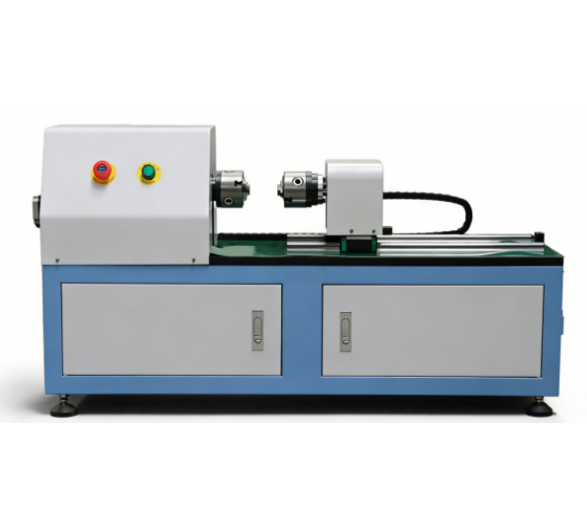
Benchtop Electronic Torsion Fatigue Testing Machine(50Nm)
Category:Material strength tester
Introduction
The Benchtop Electronic Torsion Fatigue Testing Machine (50 Nm) is a precision laboratory instrument designed for static torsion testing and torsion fatigue evaluation of various materials and shaft components. This torsion fatigue testing instrument installs the specimen between adjustable fixtures, allowing different specimen lengths and configurations to be tested efficiently.
The torsion fatigue tester is operated through a computer-based control system. During the test, the software synchronously displays the torque–time curve of the specimen, while parameters such as torque value and torque peak are monitored in real time. Test data can be stored, analyzed, and printed. The instrument supports multiple testing modes, including torque-controlled testing for torsion angle measurement and angle-controlled testing for torque measurement, as well as customized testing programs.
Application
The torsion fatigue testing machine is suitable for the following applications:
(1) Static torsion strength testing of metal and non-metal materials.
(2) Torsion fatigue life testing of shafts and rotating mechanical components.
(3) Mechanical performance evaluation of automotive and transmission components.
(4) Research testing in universities and laboratories.
(5) Quality control testing in mechanical manufacturing industries.
Standards
The torsion fatigue test instrument can be used for torsion performance testing according to common international testing methods, including:
(1) ISO 7800 (Metallic materials — Wire torsion testing)
(2) ASTM A938 (Torsion testing of metallic materials)
(3) GB/T 10128 (Metallic materials — Torsion testing method)
Introduction of Main Structure and Electrical System
(1) Main Machine:
The main machine adopts a horizontal steel plate structure. The steel plate is formed in one process to ensure high overall rigidity. The test space can be adjusted. The torque disc connected to the sensor is the torque acquisition end, and the other end is for torque loading. A precision CNC servo motor drives the loading disc to rotate through a planetary reducer, applying torque to the specimen. The torque acquisition end can move along a linear guide rail to adjust the test space and clamp the specimen. An environmental test chamber can be added if necessary.
(2) Torque Loading System:
A precision CNC servo motor drives the loading disc through a planetary reducer to apply torque evenly to the specimen, ensuring continuous speed adjustment over a wide range and uniform loading during the test process.
(3) Detection of Torque and Torsion Angle:
A high-precision torque sensor is used to collect torque in both forward and reverse directions. The torsion angle acquisition output is collected through an angle encoder. Through the computer data acquisition and processing system, the collected sensor signals are processed and displayed in real time on the computer screen.
(4) Measurement and Control System:
The entire test process adopts window-based operation software using a graphical interface based on the Windows platform. The software synchronously displays curves such as torque–time, torsion angle–time, torque–torsion angle, and torque–rotation angle of the tested specimen. Parameters such as torsion cycles, torsion angle, torque value, and torque peak are displayed in real time. Test results can be generated in report format for convenient printing and analysis.
(5) Test Process:
Select an appropriate specimen and adjust the suitable test space according to the specimen length. Place the specimen on the workbench, insert one end into the fixture body with the corresponding clamping block, slowly push the movable seat to send the specimen slowly into the fixture body at the other end, and tighten the fixture body with the clamping block using a hex wrench. After confirming that the specimen is installed, conduct the corresponding mechanical test through the torsion fatigue
measurement and control software.
Main Technical Performance Indicators
Static Torque Range: ±50 Nm
Dynamic Torque Range: ±50 Nm
Torque Measurement Range: 1%–100% FS
Minimum Torque Resolution: 0.01 Nm
Relative Error of Torque Indication: ≤ ±1.0%
Relative Repeatability Error of Torque: ≤ 1.0%
Dynamic Test Frequency: 0.1–5 Hz (depending on amplitude–frequency characteristics)
Dynamic Test Angle Measurement Range: ±360° (depending on amplitude–frequency characteristics)
Maximum Axial Test Space: 300 mm (customizable)
Temperature Range: Ambient (room temperature)
Cycle Count: 99,999,999 cycles
Test Accuracy Class: Class 1
Equipment Dimensions: Approx. 1150 × 350 × 700 mm (bench-top type)
Working Environment Requirements of the Testing Machine
(1) Within the room temperature range of 10°C–35°C; for tests with strict temperature requirements, the test temperature should be 23°C ±5°C.
(2) Relative humidity not greater than 80%.
(3) Correctly installed on a stable foundation.
(4) In a clean environment without vibration, corrosive media, or strong electromagnetic interference.
(5) The fluctuation range of the power supply voltage shall not exceed ±10% of the rated voltage.
Main Configuration List
(1) Testing machine main unit (including high-strength reinforced workbench, integrated cabinet, etc.) — 1 set
(2) Special torsion fatigue software — 1 set
(3) AC servo motor — 1 set (Panasonic, Japan)
(4) Motor driver — 1 set (Panasonic, Japan)
(5) High-precision angle sensor — 1 set (Omron, Japan)
(6) Movable fixed support seat — 1 set
(7) Fixture connection port — 1 set
(8) Bidirectional dynamic and static torque sensor — 1 set
(9) High-precision planetary reducer — 1 set
(10) Linear guide rail — 1 set
(11) Guide rail slider — 1 set
(12) Visible test protection device — 1 set
(13) Equipment sheet metal parts — 1 set
(14) Desktop computer — 1 set (Lenovo Commercial)
(15) LCD monitor — 1 set (Lenovo THINK)
(16) Printer — 1 set (HP Brand)
(17) Special fixture — 1 set
(18) Manual control device — 1 set
(19) Random tools — 1 set
(20) Random documents — 1 copy
Software Interface Introduction
Test software screenshot (standard type): data display area, curve display area, control area.
FAQ
1. What is this product?
The Benchtop Electronic Torsion Fatigue Testing Machine is a laboratory instrument used to evaluate torsion strength and torsion fatigue performance of materials and mechanical components.
2. What is this product used for?
The torsion fatigue tester is used to measure torsion resistance, fatigue durability, and mechanical performance of shafts, wires, and structural components.
3. What is the working principle of this product?
The torsion fatigue testing instrument applies controlled torque to a specimen using a servo motor and reducer system, while sensors measure torque and torsion angle for real-time analysis.
4. Why is this product important?
This torsion fatigue tester helps engineers evaluate the durability and reliability of mechanical components under repeated torsional loading conditions.
5. What industries is this product suitable for?
The instrument is widely used in automotive, aerospace, machinery manufacturing, materials research laboratories, and quality inspection institutions.