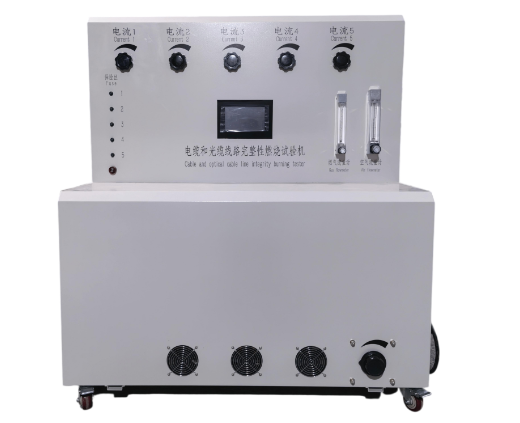
Cable and Optical Cable Integrity Burning Tester
Category:Flammability Tester
Introduction
Application
This Cable and Optical Cable Integrity Burning Tester is used for testing cables and optical cables that require maintaining circuit integrity under a single-flame test with a temperature of no less than 750 ℃, while controlling heat output.
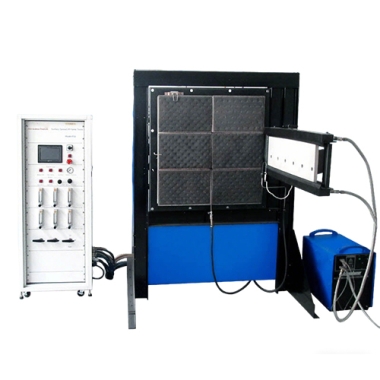
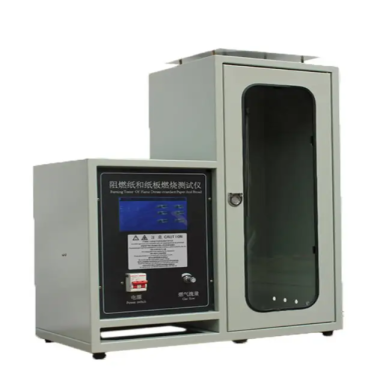
The Cable and Optical Cable Integrity Burning Tester consists of three main components: the Burning Control Box, the Fire-Resistant Test Rack, and the Control Cabinet.Both the Fire-Resistant Test Rack and the Control Cabinet are independently movable, each equipped with caster wheels at the base for easy relocation, cleaning, and maintenance.
Standards
The Cable and Optical Cable Integrity Burning Tester complies with the following standards:
GB/T 19216.21-2003 / IEC 60331-21:1999 – “Tests on electric and optical cables under fire conditions – Part 21: Test procedures and requirements – Cables rated 0.6/1.0 kV and below”
GB/T 19216.23-2003 / IEC 60331-23:1999 – “Tests on electric and optical cables under fire conditions – Part 23: Test procedures and requirements – Data cables”
GB/T 19216.25-2003 / IEC 60331-25:1999 – “Tests on electric and optical cables under fire conditions – Part 25: Test procedures and requirements – Optical cables”
Parameters
(1)Burning Chamber:
Constructed from suitable materials mounted on angle iron frames to form a cubic chamber.
Internal dimensions: 3 m × 3 m × 3 m (27 m³ total).
Structure options: brick wall or steel plate, selectable by the customer. If brick wall is chosen, customer must perform masonry.
(2)Sample Support Rack:
Samples are supported by two or three metal rings.
Horizontal fixed support: one end fixed, the other movable.
Metal ring inner diameter: 150 mm, made from Ø10 ± 2 mm round steel rods.
(3)Burning Device:
Burner Torch: Strip-type propane torch with Venturi mixer; nominal length 500 mm, width 15 mm. Three staggered rows of Ø1.32 mm drilled holes with 3.2 mm center spacing.
Torch positioned at least 200 mm above the chamber floor and 300 mm from any chamber wall.
Flow Meters: Air flow: 150 L/min; Propane flow: 8 L/min
Burner Control System: Includes pressure regulation valve, piezoelectric igniter, flame extinguishing device, temperature thermocouple, gas source (user-supplied), adjustment valve, ignition device, gas pipeline, flow meter, Venturi mixer, ball valves, air pipeline, and compressed air tank (user-supplied).
Timer: Adjustable 0–99.99 s/min/h
Ignition Device: Automatic ignition
Temperature Controller: Two-channel monitoring, adjustable range 0–1000 ℃. Flame temperature is adjusted via gas/air ratio, with real-time temperature displayed on touchscreen.
(4)Circuit Load:
Test Transformer: Three-phase, 6 kV
Test Voltage: 0.6/1.0 kV
Test Current: Standard requirement: 0.25 A
Installation Requirements (User-Supplied)
| Item | Requirement |
| Space Requirements | Control cabinet: 1400 × 600 × 1300 mm Burning chamber: L3000 × W3000 × H3000 mm (user may also provide) |
| Weight | Approx. 350 kg |
| Test Bench | L5 × W5 × H≥4 m; laboratory door H≥2.5 m, W≥2.5 m |
| Power Supply | 3-phase 380 V ±10%, 50 Hz; Power: 1100 W (equipment consumption, not compressor) |
| Water Supply | Not required |
| Gas Supply | 98% propane; air compressor pressure ≥10 MPa |
| Pollutants | Smoke and particulate matter |
| Ventilation | Ideally in open environment; if enclosed, use fume extractor or connect to dust treatment/purification system |
| Other Test Requirements | Gas cylinder with pressure-reducing valve (adjustable to 0.3 MPa)
|
FAQ
1.What is a Cable and Optical Cable Integrity Burning Tester?
A Cable and Optical Cable Integrity Burning Tester is a specialized instrument designed to evaluate the fire resistance and integrity of various types of cables, including electrical and optical cables. This testing machine simulates the conditions under which cables may be exposed to high temperatures or flames, allowing manufacturers to assess how their products will perform in real-world fire scenarios.
2.Why is testing cable integrity important?
Testing the integrity of cables is crucial for ensuring safety in electrical and data transmission systems. Cables that fail to withstand heat or flames can lead to catastrophic failures, including electrical fires, system outages, and significant economic loss. By conducting thorough testing, manufacturers can certify that their cables meet safety standards and regulations.
3.What standards are used in burning tests?
Burning tests for cables are often conducted following international standards such as IEC 60332 for vertical flame spread or IEEE 383 for cable fire performance. These standards outline specific testing parameters and criteria for evaluating the flame-retardant properties and overall safety of cables, ensuring they meet regulatory compliance.
4.How does the burning test process work?
The burning test process typically involves placing the cable or optical fiber under controlled flame exposure. The tester monitors the cable’s reaction to the heat, including any signs of melting, ignition, or flame propagation. After the test, the integrity of the cable is analyzed to determine if it meets the required safety standards and performance metrics.
5.What types of cables can be tested using this equipment?
The Cable and Optical Cable Integrity Burning Tester can be used to assess various types of cables, including power cables, communication cables (such as optical fibers), and specialty cables used in demanding environments. It is an essential tool for manufacturers in the telecommunications, energy, and construction industries.
6.Is the testing process time-consuming?
The duration of the testing process can vary based on the type of cable and the specific standards being followed. Generally, preliminary tests may take a few hours, while comprehensive evaluations can extend over several days. Manufacturers often find that investing time in thorough testing ultimately saves costs associated with recalls, failures, and safety violations in the long run.