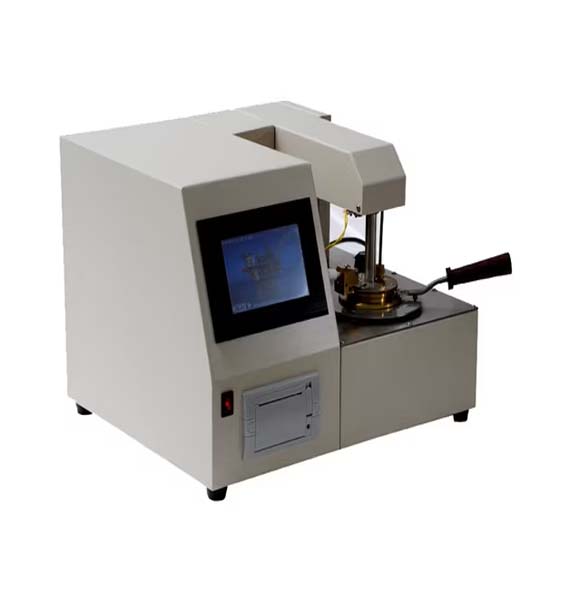
Automatic Flash Point Tester(Pensky Martens)
Category:Other
Factory Direct
Stable Performance
Intl. Standards
Tech Support
Fast Delivery
Global Shipping

Introduction
Automatic Flash Point Tester designed for accurate and repeatable determination of the flash point of petroleum products using the Pensky-Martens closed cup method, fully compliant with ASTM D93.
The flash point of a material is the lowest temperature at which it emits enough vapor to ignite in air in the presence of an ignition source. It is a critical parameter for determining the flammability and safety classification of fuels, oils, solvents, and other volatile substances.
Applications
(1)Petroleum & Petrochemical Industry – Testing fuels, base oils, lubricants
(2)Paints & Coatings – Verifying solvent flash points
(3)Pharmaceuticals & Chemicals – Assessing flammability characteristics
(4)Transport & Safety Compliance – Ensuring materials meet regulatory flash point requirements
(5)Environmental & Quality Labs – Standardized material classification
Standards
(1)SN/T 3077.1-2012: Chemicals—Determination of flash point—Part 1: Closed-cup equilibrium method
(2)SN/T 3077.2-2012: Chemicals—Determination of flash point—Part 2: Closed-cup rapid equilibrium method
(3)SH/T 0768-2005: Determination of total contaminants in middle distillate fuel oils—High-temperature filtration method
(4)DL/T 1354-2014: Preparation method of working standard oil for analysis of dissolved gas components in transformer oil
(5)ASTM D93: Pensker-Martins closed-cup flash point determination
(6)ASTM D6450: Small closed-cup flash point determination method
(7)ASTM D3828: Small closed-cup device method for determining the flash point of liquids
(8)ASTM D7094: Improved continuous closed-cup flash point determination method
(9)ASTM D7236: Improved Abel closed-cup flash point determination method
(10)ASTM D56: Tiger closed-cup flash point determination method
(11)ISO 2719: Petroleum products—Determination of flash point—Pensker- Martins Closed Cup Method
(12)ISO 13736: Petroleum Products – Determination of Flash Point – Abel Closed Cup Method
(13)ISO 1516: Petroleum Products – Determination of Flash Point – Tiger Closed Cup Method
(14)ISO 1523: Petroleum Products – Determination of Flash Point – Small Closed Cup Method
(15)IP 34: Determination of Flash Point – Abel Closed Cup Tester Method
(16)IP 304: Determination of Flash Point – Small Closed Cup Method
(17)IP 170: Determination of Flash Point – Pensker-Martins Closed Cup Tester Method
(18)DIN EN 22719: Petroleum Products – Determination of Flash Point – Pensker-Martins Closed Cup Method
(19)JIS K2265: Petroleum Products – Determination of Flash Point
(20)NF M 07-019: Petroleum Products – Determination of Flash Point – Pensker-Martins Closed Cup Method
Technical Parameters
| Operating Environment | (5~40)℃, <85%RH |
| Temperature Range | (0~260)℃ |
| Rising Rate | (-30~260)℃ (with low-temperature module) |
| Temperature Detection Accuracy | (0~420)℃ (with high-temperature module) |
| Pressure Detection Range | (-30~420)℃ (with low-temperature and high-temperature modules) |
| Sample Volume | (2.5±0.3)℃/min, (5.5±0.5)℃/min, |
| Ignition Method | (0.5~12)℃/min Customized |
| Stirring Speed | ±0.1℃ |
| Storage Space | (0~ 200)kPa |
| Interface | 1mL or 2mL |
| Power | High-pressure electronic ignition |
| Power | (50~300)rpm software can be set |
| Dimensions | 5000 test results |
| Weight | RS232*1. RJ45*1. USB*2 |
Accessoriess
(1) Binsky-Martin Closed Cup Kit (includes a dedicated cup body and sealing cap, suitable for closed cup testing requirements)
(2)Micro-sample pipette (matches the instrument’s micro-sample volume injection requirements)
(3)Spare ignition needle/igniter assembly (a spare part to ensure stable ignition function)
(4) Sealing ring for closed cup (a consumable sealing component for closed cup testing)
(5)Spare temperature sensor probe (a core spare part for temperature detection)
(6)Standard flash point sample for calibration (a known flash point standard oil compatible with ASTM D93, used for instrument calibration)
(7)Dedicated cleaning tools (such as brushes and wiping cloths, for cleaning and maintenance of components such as the cup body)
Maintenance Information
(1)Routine Inspection: Check the condition of the ignition system, thermocouples, and cup assembly before each test to ensure proper operation.
(2)Cleaning: After each measurement, clean the test cup, lid, and surrounding components to prevent residue buildup and contamination.
(3)Calibration and Safety Checks: Periodically verify the temperature sensor and ignition timing accuracy, and ensure all safety interlocks are functional.
FAQ
1. What is the Micro Rapid Closed Cup Flash Point Tester used for?
It is used to determine the flash point of liquids, indicating flammability and fire hazard levels for safety and regulatory compliance.
2. Which types of liquids can be tested?
The tester can analyze petroleum products, fuels, lubricants, and other flammable liquids according to Pensky-Martens standards.
3. How does the tester work?
The liquid sample is heated in a closed cup while an ignition source intermittently tests for vapor ignition, recording the temperature at which a flash occurs.
4. What safety features are included?
It includes thermal cutoffs, ignition system interlocks, and protective shields to prevent accidents during testing.
5. How should the tester be maintained?
Maintenance involves cleaning the cup and lid after each test, checking thermocouples and ignition components, and periodically calibrating the temperature sensors to ensure accurate results.
If you're ready to take the next step, Leave your message below and we'll reply soon. 20+ years of manufacturing & export experience, a partner you can trust.