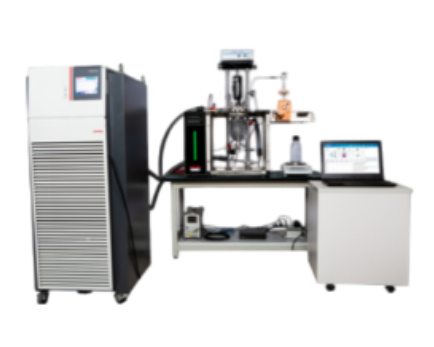
Automatic Reaction Calorimeter
Category:Flammability Tester
Factory Direct
Stable Performance
Intl. Standards
Tech Support
Fast Delivery
Global Shipping

Introduction
This Automatic Reaction Calorimeter is a professional testing instrument that simulates the specific process of chemical reactions on a liter scale, and measures and controls important process variables. It can simulate the real situation of batch or semi-batch reactions in a factory under laboratory conditions.
Applications
This Automatic Reaction Calorimeter simulates real-world intermittent or semi-intermittent reactions in a factory, measuring the exothermic heat flow of samples within the reactor in real time. It obtains information on the total exothermic heat, specific exothermic heat, real-time conversion rate, and material accumulation, automatically calibrating the specific heat capacity and heat transfer coefficient of the material system. It then calculates the adiabatic temperature rise of the target reaction and the maximum temperature the system can reach after runaway, thereby assessing the hazard level of the reaction process and providing a basis for process optimization and scale-up. It is widely used in reaction process design, process optimization and scale-up, process safety assessment, and scientific research on reaction thermodynamics in fields such as fine chemicals, pharmaceuticals, agricultural fertilizers, and third-party safety assessment.
Standards
(1)GB 51283-2020: Fire Protection Standard for Engineering Design of Fine Chemical Enterprises
(2)GB/T 22232-2008: Determination of Thermal Stability of Chemical Substances – Differential Scanning Calorimetry
(3)GB/T 17802-2011: Thermal Analysis Test Method for Kinetic Constants of Thermally Unstable Substances
(4)SN/T 3078.1-2012: Guidelines for the Evaluation of Thermal Stability of Chemicals – Part 1: Accelerated Calorimetry
Technical Parameters
| Calorimetry Method | Heat Flow, Power Compensation (Option), Reflow (Option) |
| Temperature Control | |
| Kettle Temperature Range | (-25 to 200)°C |
| Oil Bath Temperature Range | (-45 to 250)°C |
| Control Method | Isothermal, Constant Temperature, Scanning |
| Temperature Resolution | 1.0mK |
| Temperature Control Precision | ±0.1K |
| Silicone Oil Circulation Speed | (35 to 76)L/min |
| Control | |
| Driver Voltage Range | (0 to 50)VDC |
| Driver Maximum Current | 3.0A |
| Heater Maximum Power | 120W |
| Atmospheric Pressure Glass Kettle (Option) | 1000mL, other volumes available |
| Reactor Volume | Atmospheric Pressure |
| Working Pressure | Glass |
| Reactor Material | Medium-Pressure Glass Kettle (Option) |
| Medium-Pressure Glass Kettle (Option) | |
| Reactor Volume | 0.6MPa or 1.2MPa |
| Working Pressure | Glass |
| Kettle Material | 316L Stainless Steel or Hastelloy |
| Kettle Lid Material | 1000mL, other volumes customizable |
| High-Pressure Metal Reactor ( (Optional) | 10MPa |
| Reactor volume | 316L Stainless Steel or Hastelloy |
| Working pressure | Stirrer |
| Reactor material | 2000r/min, 3000r/min optional |
| Stirrer | |
| Maximum speed | Anchor or Paddle |
| Maximum torque | PTFE, 316L, or Hastelloy |
| Stirrer paddle form | Sampling system |
| Stirrer paddle material | Range 3100g, Accuracy 0.01g |
| Sampling system | |
| Precision balance | Medium-pressure pump: electromagnetic diaphragm pump, the maximum flow rate of 2L / h; high-pressure pump: precision piston pump, the maximum flow rate of 2.4L / h |
| Sampling channel | 3*400V/50Hz(±10%)/20A |
| Sampling pump | 7000VA |
| Other parameters | 1200mm*600mm*1850mm |
| Power supply | 600mm*700mm*1300mm |
| Power | 210kg |
| Test area size | 300kg |
| Oil bath size | Heat Flow, Power Compensation (Option), Reflow (Option) |
| Oil bath weight | Temperature Control |
| Total machine weight | (-25 to 200)°C |
Accessoriess
(1)Optional reactor types: Glass atmospheric pressure reactor, glass medium pressure reactor, metal high pressure reactor
(2)Functional components: High-power heating/cooling unit, automatic feeding control unit (supports mass/volume measurement)
(3)Auxiliary modules: External database module, Chinese experimental software platform
Maintenance Information
(1)Routine Inspection: Check sensors, pumps, stirrers, and temperature probes for wear, damage, or leaks before each test to ensure accurate measurements.
(2)Cleaning: After each experiment, thoroughly clean the reaction vessel, probes, and fluid circuits to prevent contamination and residue buildup.
(3)Calibration and Safety Checks: Periodically verify temperature sensors, pressure transducers, and flow meters; ensure all safety interlocks and emergency shutdown systems are functional.
FAQ
1. What is the Automatic Reaction Calorimeter used for?
It is used to measure the heat released or absorbed during chemical reactions, providing critical data for reaction kinetics, safety, and scale-up studies.
2. Which types of reactions can be tested?
It can analyze exothermic, endothermic, and complex multi-step chemical reactions in liquid, slurry, or solution phases.
3. How does the calorimeter work?
The device monitors temperature, pressure, and heat flow in a controlled reaction vessel, automatically recording data to calculate reaction enthalpy and rate.
4. What safety features are included?
It includes over-temperature protection, pressure relief systems, emergency shutdowns, and automated control to prevent hazardous conditions.
5. How should the calorimeter be maintained?
Maintenance involves inspecting sensors and stirrers, cleaning the reaction vessel and fluid circuits, and calibrating temperature and pressure sensors regularly.
If you're ready to take the next step, Leave your message below and we'll reply soon. 20+ years of manufacturing & export experience, a partner you can trust.