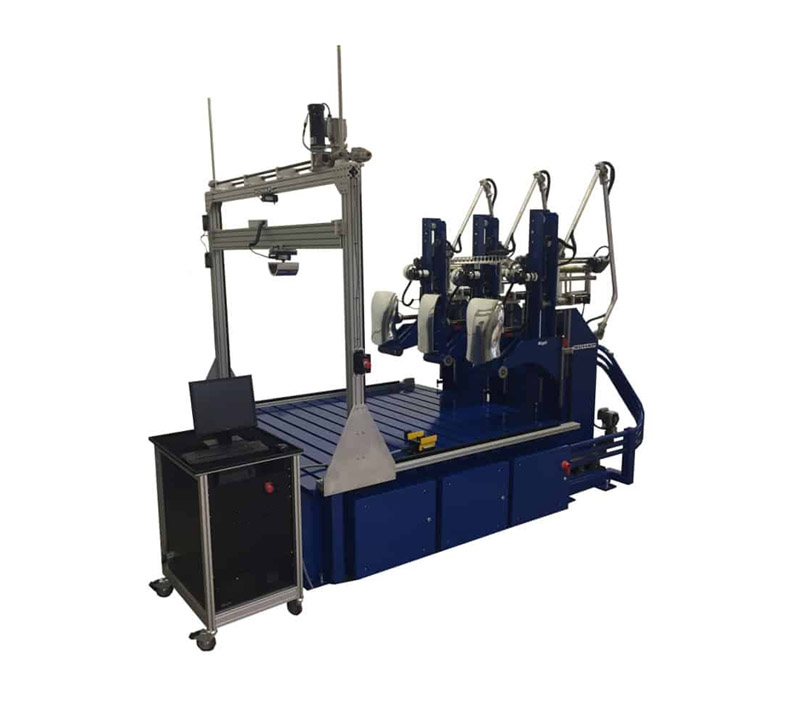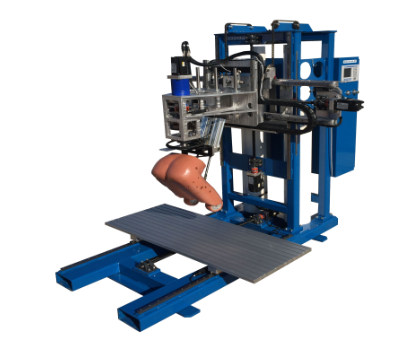
Automotive Seat Dynamic Comfort Tester
Category:Static & Dynamic Load
Introduction
1. Product Overview
The Automotive Seat Dynamic Comfort Tester is designed to evaluate seat performance under dynamic conditions. It measures key parameters such as dynamic stiffness, natural frequency, damping ratio, and vibration transmissibility curves. These metrics help engineers and designers assess how a seat responds to vibrations and dynamic loads, providing essential insights into occupant comfort and seat performance under real-world driving conditions.
2. Product Features
Simulates vertical and horizontal dynamic loads on automotive seats.
Measures dynamic stiffness, natural frequency, damping ratio, and vibration transmissibility.
Adjustable vertical and horizontal stroke to accommodate various seat designs.
Capable of simulating pitch motion with adjustable angle ranges.
High-precision force and displacement control ensures accurate and reliable results.
Applicable for R&D, comfort evaluation, quality control, and certification testing.
3. Applicable Standards
QC/T 55-1993 – Test methods for dynamic comfort of automotive seats.
Supports parameter tests as specified in Section 6 of QC/T 55-1993.
4. Technical Parameters
| Parameter | Specification |
|---|---|
| Vertical Load | 500 – 5000 N |
| Horizontal Load | 200 – 2000 N |
| Vertical Stroke | ±50 – ±200 mm |
| Horizontal Stroke | ±30 – ±150 mm |
| Pitch Angle Range | ±5° – ±30° |
| Vertical Vibration Frequency | 0.5 – 20 Hz |
| Horizontal Vibration Frequency | 0.2 – 10 Hz |
| Force Control Accuracy | ±1% – ±3% FS |
| Displacement Control Accuracy | ±0.1 – ±0.5 mm |
| Power Supply | AC 380 V, 50 Hz |
5. Optional Accessories
Additional mounting adapters for different seat types.
High-precision force and displacement sensors for enhanced measurement accuracy.
Data acquisition and analysis software for real-time monitoring and reporting.
Environmental simulation accessories for testing under temperature or humidity variations.
Protective enclosures and safety devices for operator protection.
6. Operation Method & Maintenance
Operation Method
Secure the automotive seat on the test platform using appropriate fixtures.
Set the test parameters including load ranges, stroke, pitch angle, and vibration frequency.
Start the system to apply dynamic loads while recording force, displacement, and vibration data in real time.
Analyze the results to assess seat comfort, stiffness, damping, and vibration transmissibility.
Maintenance
Inspect mechanical components and mounting fixtures regularly for wear or damage.
Calibrate force and displacement sensors periodically to maintain accuracy.
Ensure control system and data acquisition devices are free from dust and moisture.
Check safety features, including emergency stop and protective enclosures, before each test.
Lubricate moving parts according to the manufacturer’s maintenance schedule to ensure smooth operation.