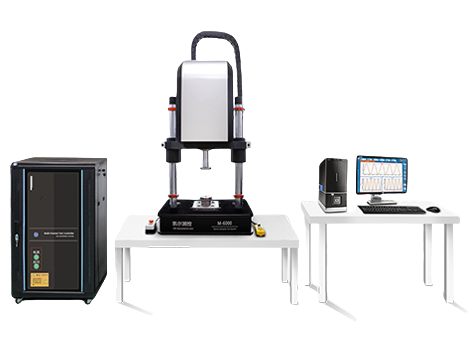
Dental Implant Fatigue Testing Machine
Category:Medical Device Tester
Factory Direct
Stable Performance
Intl. Standards
Tech Support
Fast Delivery
Global Shipping

Introduction
The Dental Implant Fatigue Testing Machine is a specialized device used to evaluate the mechanical durability and fatigue performance of dental implants. It simulates repeated masticatory or occlusal forces under controlled conditions to assess the implant’s resistance to cyclic loading, predict service life, and ensure reliability and safety for long-term clinical use.
Standards
This device complies with standards specifying the fatigue testing methods for transmucosal single-piece endosseous dental implants and their prefabricated prosthetic components. It is designed to compare the fatigue strength of dental implants of different designs and sizes. The fixture features an adjustable-angle design to accommodate specimens both with and without prefabricated angulation, and it supports standard water bath environmental testing. The test protocol is 2 Hz for 2 million cycles.
The M-series electromagnetic equipment provides precise sinusoidal load control with stable peak values. It can be equipped with comprehensive testing fixtures (adjustable prefabricated angles, water bath environment, etc.) to meet standard test requirements and deliver accurate, effective test procedures (SOPs), facilitating mechanical performance analysis or comparative studies of dental implants with different designs.
Application
The machine is used to evaluate the mechanical durability and fatigue resistance of dental implants, abutments, and prosthetic components under simulated oral conditions. It helps predict long-term performance, optimize implant design, and ensure compliance with international standards for dental implant safety and reliability.
Specifications
| Parameter | Specification |
|---|---|
| Maximum Load Peak | 4400 N |
| Dynamic Load Peak | 3000 N |
| Static Load Peak | 2100 N |
| Machine Class | 0.5 |
| Load Measurement Range | 0.4%–100% F.S. |
| Load Measurement Accuracy | ±0.2% of indicated value (within measurement range) |
| Maximum Fatigue Loading Frequency | 100 Hz |
| Axial Travel | 30 mm |
| Displacement Resolution | 0.1 μm |
| Test Space (between upper and lower fixtures) | 0–950 mm |
| Net Weight | ~900 kg |
| Dimensions | ~1000 × 700 × 1800 mm |
| Optional Environmental Accessories | Water bath, high temperature, low temperature, humidity environment, etc. |
| Applicable Scenarios | Fatigue, fracture, and static testing of metals, polymers, and composite materials; Static and dynamic testing of surgical implants (including trauma, joint, spine, and dental applications); Tensile fatigue testing of polymer materials; Crack propagation testing of rubber materials |
| Optional Fixtures | Mechanical tensile, compression, and bending clamps; Specialized clamps for femoral stems, four-point bending, spinal rods/screws, tibial plateau, vertebral resection models for compression/tension, dental implants, etc. |
Features
New-generation fatigue testing system driven by a large electromagnetic motor.
Direct-drive electromagnetic motor ensures stable operation, high repeatability, and precise control of force and displacement.
Built-in electromagnetic actuator features low friction and high repeatability, with fast system response and high speed.
Capable of performing tension, compression, bending, shear, creep, and relaxation tests.
Meets strict requirements for modern material mechanics testing, including high precision, high frequency, high stability, and durability.
Features oil-free, seal-free, maintenance-free design, long service life, high integration, easy installation, and compact footprint.
Supports a variety of clamps and accessories.
Accessories
(1)Load applicators and fixtures for different implant sizes.
(2)Servo-hydraulic or electromechanical actuators.
(3)Artificial bone blocks or mounting jigs for implant placement.
(4)Sensors for force, displacement, and cycle counting.
Maintenance Information
Clean fixtures, actuators, and sensors after each test to avoid contamination.
Calibrate load cells and displacement sensors regularly.
Inspect mechanical parts for wear or damage and replace if necessary.
Lubricate moving components and ensure software is updated for accurate testing.
FAQ
1.What is the purpose of the Dental Implant Fatigue Testing Machine?
It evaluates the mechanical durability and fatigue resistance of dental implants under simulated oral conditions.
2.Which standards does the machine comply with?
It typically follows ISO 14801 and other relevant dental implant fatigue and safety standards.
3.Can it test different implant sizes and types?
Yes, the machine supports various implant diameters, lengths, and abutment designs using interchangeable fixtures.
4.How is the test conducted?
Implants are mounted in artificial bone blocks or fixtures, then subjected to cyclic axial and lateral loads while monitoring displacement and load cycles.
5.What maintenance is required to ensure accurate results?
Regular calibration of sensors, cleaning of fixtures, inspection of mechanical components, and lubrication of moving parts are necessary.
If you're ready to take the next step, Leave your message below and we'll reply soon. 20+ years of manufacturing & export experience, a partner you can trust.