Enamel Boiling Water Resistance Tester
Category:Other
Factory Direct
Stable Performance
Intl. Standards
Tech Support
Fast Delivery
Global Shipping

Introduction
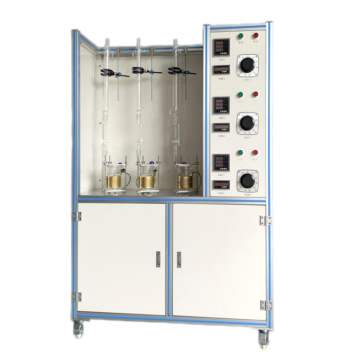
The Enamel Boiling Water Resistance Tester is designed to evaluate the chemical attack resistance of enamel coatings under boiling water conditions. It accurately measures the weight loss of enamel layers when exposed to acidic, neutral, or alkaline solutions at high temperatures, providing reliable data for quality control, material research, and production process optimization. The instrument meets both national and international standards for enamel chemical resistance testing.
Application
(1) Testing the boiling water resistance of enamel coatings on household appliances such as kitchenware, sinks, bathtubs, and cookware.
(2) Evaluation of enamel coatings on industrial equipment, including chemical storage tanks, heat exchangers, and piping.
(3) Assessment of protective coatings on metal furniture and construction materials.
(4) Quality control of enamel coating manufacturing in factories and laboratories.
(5) Research and development of new enamel formulations and coating technologies.
(6) Comparative testing of acidic, neutral, and alkaline corrosion resistance for product certification and standards compliance.
Standards
(1) QB/T 2590-2003 Appendix A: Enamel Boiling Water Resistance Test.
(2) GB/T 9989-2015: Test method for chemical attack resistance of enamel coatings.
(3) ISO 28706-2:2008: Determination of chemical attack resistance of enamel coatings, Part 2: Resistance to boiling acid, boiling neutral liquid, and vapor.
(4) ASTM D870-17: Standard Test Method for Water Resistance of Coatings Using Boiling Water.
(5) EN 12894: Glass and enamel surface resistance to chemical attack.
Parameters
| Parameter | Specification |
|---|---|
| Voltage | AC 175V adjustable |
| Heating method | Electric heating ring |
| Sample holder | Stainless steel triangle plate with hexagonal nuts |
| Condensate collection | Graduated condensate collector with serpentine condensing pipe |
| Sample type | Enamel-coated metal substrates |
| Test liquid | Distilled water, acidic or alkaline solutions |
| Boiling observation | 30–50 drops/min condensate rate |
| Power supply | AC 220V, 50Hz |
| Dimensions | According to configuration (glass cylinder, plates, and base) |
| Weight | Dependent on configuration |
Features
(1) Standard Compliance: Fully adheres to national and international standards for enamel chemical resistance testing.
(2) Accurate Measurement: Provides precise determination of enamel weight loss after exposure to boiling liquids.
(3) Adjustable Heating: Voltage regulator allows gradual heating to maintain consistent boiling conditions.
(4) Condensate Collection System: Equipped with graduated condensate collector and serpentine condensing pipe to ensure proper vapor recycling.
(5) Safety Design: Includes protective measures for electrical safety and anti-scald operation.
(6) Modular Setup: Glass, rubber, and PTFE components are easily assembled and disassembled for flexible testing.
(7) Visual Monitoring: Transparent components allow observation of boiling and condensation during testing.
(8) Versatile Testing: Supports liquid phase and gas phase chemical erosion tests.
Accessories
(1) Glass cylinder
(2) Stainless steel triangle plates
(3) Rubber washers
(4) PTFE square plates
(5) Heating ring
(6) Graduated condensate collector
(7) Serpentine condensing pipe
(8) Power cable
(9) User manual
Maintenance Information
(1) Handle all glass components with care; avoid shocks or impacts.
(2) Regularly inspect the heating ring and electrical connections for wear.
(3) Clean rubber and PTFE components to avoid residue buildup.
(4) Ensure condensate collector and pipes are free of blockages.
(5) Store the instrument in a clean, dry, and stable environment.
(6) Follow standard safety protocols during assembly, testing, and disassembly.
FAQ
1. What is the primary purpose of this tester?
It evaluates the resistance of enamel coatings on metal or ceramic substrates to boiling water, assessing durability and adhesion under high-temperature moisture exposure.
2. Which materials can be tested using this device?
The tester is suitable for enamel-coated cookware, kitchenware, appliances, and decorative or protective enamel coatings on metals and ceramics.
3. How does the tester operate?
It immerses enamel-coated samples in boiling water for a specified period and then evaluates for peeling, blistering, or other coating degradation.
4. Which standards does this tester comply with?
It supports international enamel and cookware testing standards, including ISO 4532. GB/T 17409. and relevant national or industry-specific protocols.
5. Who typically uses this equipment?
Cookware manufacturers, coating producers, quality control laboratories, and R&D teams use it to ensure product durability, maintain safety, and optimize enamel formulations.
If you're ready to take the next step, Leave your message below and we'll reply soon. 20+ years of manufacturing & export experience, a partner you can trust.