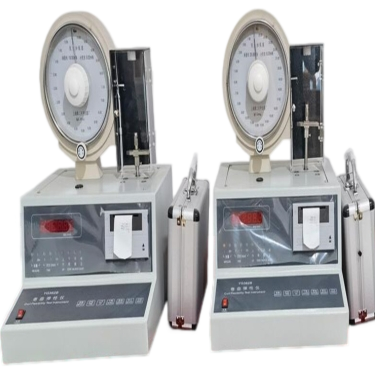
Fiber Crimp Elasticity Testing Machine
Category:Fabric & Textile Tester

Introduction
The Fiber Crimp Elasticity Testing Machine is a specialized instrument designed to measure the crimp degree, crimp elasticity, and crimp recovery rate of fibers with linear densities from 1 to 22 dtex. It is widely used in fiber research, production, and quality inspection departments to evaluate both natural and chemical fibers, providing accurate and repeatable measurements for fiber performance analysis and process optimization.
Application
(1) Testing crimp degree and crimp recovery rate of synthetic fibers such as polyester, nylon, acrylic, and rayon.
(2) Evaluating natural fibers including cotton, wool, and blended fibers for crimp elasticity.
(3) Fiber research and development in textile laboratories and nonwoven material production.
(4) Quality control in fiber spinning, carding, and finishing processes.
(5) Comparative studies of crimp performance for recycled or blended fibers.
(6) Assessment of fibers used in technical textiles for automotive, medical, and smart textile applications.
(7) Education and training purposes in fiber science and textile engineering programs.
Standards
(1) GB/T 14338-2008: Test method for crimp and crimp elasticity of staple fibers.
(2) GB/T 14338-2022: Updated national standard for crimp performance of man-made staple fibers.
(3) ISO 2060: Determination of fiber fineness by electrical or physical methods (applied analogously).
(4) ASTM D885: Standard test methods for crimp characteristics of textile fibers.
(5) EN 1269-1: Test methods for staple fibers—crimp characterization and recovery rate measurement.
(6) JIS L 1013: Methods for evaluating crimp and elasticity of textile fibers.
Parameters
| Parameter | Specification |
|---|---|
| Tension loader range | 0–5.00 mN (min division 0.01 mN), 0–10.00 mN (min division 0.02 mN), 0–25.00 mN (min division 0.05 mN) |
| Initial length | 20 mm |
| Lower clamp stroke | ≤30 mm |
| Displacement resolution | 0.01 mm |
| Timing | Automatic, selectable: 30s, 60s, 120s |
| Lighting | LED lights |
| Crimp count length | 25 mm |
| Power supply | AC 220V, 50 Hz |
Accessories
(1) Main unit
(2) Fiber clamps and tension loaders
(3) Sample holder
(4) LED observation lamp
(5) Power cable
(6) User manual
Maintenance Information
(1) Keep the clamps and tension loading components clean to prevent measurement errors.
(2) Check the LED lighting and replace bulbs as necessary.
(3) Verify timing and tension accuracy periodically using calibration fibers.
(4) Avoid exposure to moisture, dust, or corrosive substances.
(5) Store the instrument in a stable laboratory environment with controlled temperature and humidity.
(6) Inspect mechanical components regularly for wear and lubricate moving parts as recommended.
FAQ
1. What is the primary purpose of this tester?
It measures the crimp elasticity of fibers to assess their resilience, recovery, and elongation properties after deformation.
2. Which types of fibers can be tested using this device?
The tester is suitable for wool, cotton, synthetic fibers, and other textile fibers where crimp or texture affects performance.
3. How does the tester operate?
It stretches or compresses fibers with controlled force, measures their elongation and recovery, and evaluates crimp stability and elasticity.
4. Which standards does this tester comply with?
It supports international fiber testing standards, including ISO 7211. ASTM D2256. and relevant textile industry protocols.
5. Who typically uses this equipment?
Textile manufacturers, fiber producers, quality control laboratories, and R&D teams use it to evaluate fiber performance, optimize material selection, and ensure consistent product quality.
If you're ready to take the next step, Leave your message below and we’ll reply soon. 20+ years of manufacturing & export experience, a partner you can trust.