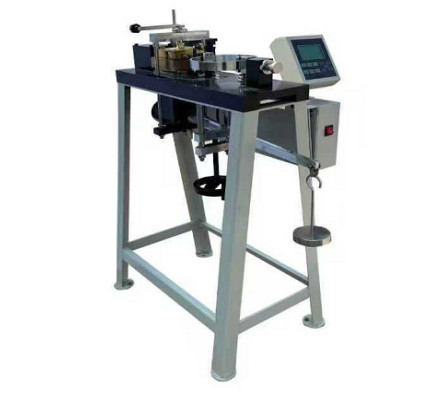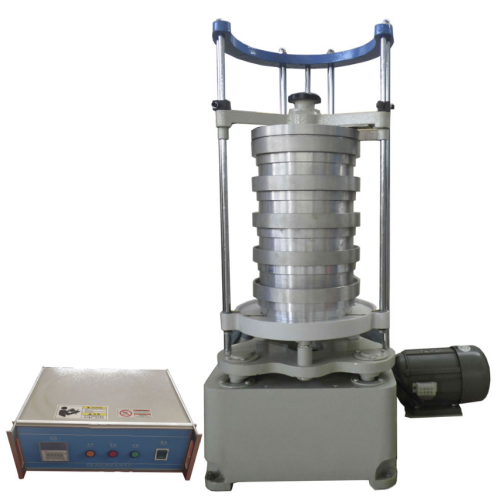
Geotextile Effective Aperture Tester
Category:Material Strength Tester
Factory Direct
Stable Performance
Intl. Standards
Tech Support
Fast Delivery
Global Shipping

Introduction
Geotextiles are fabrics made primarily from synthetic fibers through processes such as needle punching and heat bonding. They possess excellent water permeability, high strength, and corrosion resistance, and can effectively separate, filter, and drain, making them widely used in various fields such as soil stabilization, drainage, and erosion control. Based on the materials used, geotextiles can be divided into two main categories: non-woven fabrics and woven fabrics.
Application
The equivalent pore diameter of geotextile and its related products was determined by dry screening method. The geotextile sample is used as the screen cloth, the standard particle material with known diameter is placed on the geotextile above the vibrating screen, and the sieve rate is calculated by weighing the standard particle material weight of ten industrial cloth, and the sample is replaced by the standard particle material with different diameters. The aperture distribution curve of the textile is drawn and the value of 090 is obtained.
Standard
GB/T14799-2005: Geotextiles and geotextile-related products – Determination of the effective opening size – Dry sieving method
ASTM D4751-2004: Standard Test Method for Determining Apparent Opening Size of a Geotextile
SL/T 235-7-2012: Specification for Test and Measurement of Geosynthetics (Chapter 7 or relevant section, if applicable)
Parameters
| Specification | Details |
|---|---|
| Inner diameter of the screen | 200mm |
| Screen material | Aluminum |
| Screen stack height | 400mm |
| Screen seat amplitude | 8mm |
| Vibration frequency 1 | 221/min |
| Vibration frequency 2 | 147/min |
| Turning radius | 12.5mm |
| Timer range | 0 to 99 minutes and 59 seconds |
| Power supply | AC 380V 50HZ |
| Dimensions – Host | 600x380x1000mm |
| Dimensions – Control box | 330x290x105mm |
| Weight | 130kg |
Features
Adopts split type design to avoid damage to the control system caused by vibration during high-speed operation.
Using mechanical vibrating screen vibration, smooth and efficient;
Vibrating screen can carry out shaking and shaking two vibration modes, vibration frequency is stable;
Equipped with locking protection device, strengthen the stability of the fuselage;
It is equipped with an anti-static device to prevent glass beads from gathering on the surface of the sample due to electrostatic action;
+5 sets of sieve parallel sample test, energy saving and high efficiency;
Digital display time, vibration time can be set;
Easy to install, easy to operate.
Accessoriess
Standard sample holder
Particle dispensing device
Vibratory sieving system
Collection and weighing device
Data recording and analysis software
Calibration tools
Cleaning and maintenance tools
(e.g., soft brush, vacuum cleaner, etc., for cleaning residual particles and maintaining equipment cleanliness)
FAQ
1. What is a Geotextile Effective Aperture Tester?
The Geotextile Effective Aperture Tester is a device designed to measure the effective pore size (aperture) of geotextiles. It evaluates how the material will perform in filtration, drainage, and soil retention applications.
2. How does the machine test effective aperture?
The tester passes standardized soil or particle suspensions through the geotextile sample and measures particle retention or flow characteristics. The effective aperture is calculated based on the size of particles that can pass through the fabric.
3. What types of geotextiles can be tested?
It can test woven, nonwoven, and knitted geotextiles used in civil engineering, road construction, erosion control, and drainage projects. The machine accommodates different sample sizes and thicknesses.
4. What parameters are measured during testing?
The machine measures effective pore size (aperture), particle retention, filtration efficiency, and sometimes flow rate under specified conditions. Results help predict the geotextile’s performance in real-world soil and water applications.
5. Why is effective aperture testing important?
Testing ensures that geotextiles allow proper water flow while retaining soil particles, preventing erosion and structural failure. It helps engineers and manufacturers select the right material for specific construction or environmental applications.
If you're ready to take the next step, Leave your message below and we'll reply soon. 20+ years of manufacturing & export experience, a partner you can trust.