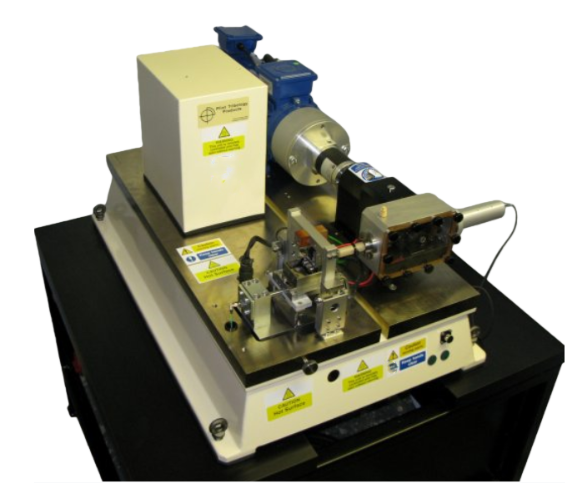
High Frequency Friction Machine
Category:Abrasion Tester

Introduction
The High Frequency Friction Machine is a reciprocating tribological testing instrument designed to study high-frequency friction, wear, and tribological behavior of metals, ceramics, and composite materials under dry or lubricated conditions. You can apply controlled loads up to 1,000 N over a maximum stroke of 25 mm while precisely controlling frequency, temperature, and test sequence via PC interface and dedicated software. The system has been validated through multi-laboratory comparisons during ASTM G133 and ASTM G181 standard development, ensuring high reliability and international recognition.
Application
You can use this instrument for:
(1) Investigating dry and lubricated wear of metals, ceramics, and ceramic-based composites.
(2) Linear reciprocating ball-on-flat friction and wear tests.
(3) Evaluating friction performance of piston rings and cylinder liner materials under lubrication.
(4) Studying friction and wear of surface-engineered materials, including coatings and treated layers.
(5) Friction noise and stability analysis under reciprocating contact.
(6) Low-speed sliding and stick-slip behavior studies.
(7) Investigation of friction potential, contact states, and lubricating film formation.
(8) Simulation of gear, cam-follower, and rolling-sliding composite contact mechanisms.
(9) Fretting wear and impact fretting wear testing.
(10) Tribological testing under inert, low-temperature, or corrosive environments.
Standards
You can perform tests in accordance with:
(1) ASTM G133 – Linear Reciprocating Ball-on-Flat Sliding Wear Test
(2) ASTM G181 – Friction Test Method for Piston Rings and Cylinder Liner Materials
(3) ASTM D5706 / D5707 / D6079 – Lubrication and friction-related testing
(4) ASTM G203 / G206 – Friction, wear, and surface failure testing
(5) ISO/DIS 12156-2 – Lubricity evaluation (HFRR related)
(6) BS EN 1071-12 – Advanced ceramics friction and wear testing
(7) CEC F-06-A-96 – Diesel fuel lubricity evaluation
(8) DEF STAN 91-110/1 – Fuel lubrication performance assessment
Parameters
| Parameter | Specification |
|---|---|
| Contact Type | Ball-on-Flat (point contact) / Cylinder-on-Flat (line contact) / Plane contact |
| Optional Contact | Piston ring–cylinder liner |
| Load Range | 5–1,000 N |
| Loading Rate | 50 N/s |
| Frequency Range | 2–50 Hz |
| Maximum Stroke | 25 mm |
| Temperature Range | Ambient to 600°C |
| Heating Power | 800 W |
| Temperature Sensor | K-type thermocouple |
| Friction Force Sensor | Piezoelectric |
| Force Measurement Range | ±500 N |
| Stroke Sensor | Magnetic induction |
| Linearity | 0.50% |
| Motor | 1.1 kW AC vector motor (2048 ppr encoder) |
| Contact Potential | 50 mV DC |
| Software | Software |
| Data Interface | USB (high speed) / Serial (low speed) |
Features
(1) Genuine sinusoidal reciprocating motion (Scotch Yoke) ensures stable, repeatable displacement.
(2) Maximum 25 mm stroke allows effective wear generation compared to short-stroke electromagnetic systems.
(3) Servo and spring combined loading provide precise load control.
(4) Optional reduction gearbox enables ultra-low-speed testing down to 0.01 Hz.
(5) Simultaneous acquisition of low-speed trend and high-speed transient data up to 50 kHz.
(6) Friction noise measurement for analysis of lubrication status and friction stability.
(7) Supports rolling-sliding, fretting, and impact fretting wear simulations.
(8) Modular accessory system enables expansion for diverse engineering tribology applications.
Accessories
Standard Ball-on-Flat Test Assembly – 6 mm / 10 mm balls
Standard Line Contact Tool – Ø6 mm × 16 mm
Optional TE 77/WEAR – Online wear monitoring system
Optional TE 77/PROFILE – In-situ profilometer
Optional Piston Ring Fixture – Adjustable curvature
Optional Inert Gas Chamber – Inert or corrosive atmosphere
Optional Cooling Module – Minimum -50°C
Consumables: Ball specimens – steel, ceramic, etc.
Consumables: Plate specimens – typical 38 × 58 × 4 mm
Maintenance Information
(1) Ensure power and installation meet required specifications.
(2) Check alignment and surface cleanliness of specimens before each test.
(3) Verify temperature control system and safety devices before high-temperature tests.
(4) Ensure proper lubricant supply and debris removal for long-stroke or low-frequency tests.
(5) Monitor data storage capacity during high-speed acquisition.
(6) Check sealing when testing under inert or corrosive atmospheres.
(7) Strictly control stroke and frequency settings for fretting and impact tests.
FAQ
(1) What is this product?
It is a high-frequency reciprocating tribometer designed to study friction, wear, and tribological behavior of materials under dry or lubricated conditions.
(2) What is this product used for?
You can use it to evaluate friction, wear, lubrication effects, stick-slip behavior, and fretting under controlled laboratory conditions.
(3) How does this product work?
The instrument uses a motor-driven Scotch Yoke mechanism to generate sinusoidal reciprocating motion. Load is applied via servo-assisted lever systems, friction is measured with piezoelectric sensors, and temperature is controlled with a heating module and thermocouples. High-speed and low-speed data channels capture transient and long-term behavior.
(4) Why is this product important?
It allows precise analysis of material friction and wear, friction stability, lubrication performance, and fretting mechanisms, supporting material development and industrial reliability assessment.
(5) Which industries is this product suitable for?
Automotive, aerospace, energy, advanced ceramics, industrial machinery, and material research laboratories.
If you're ready to take the next step, Leave your message below and we’ll reply soon. 20+ years of manufacturing & export experience, a partner you can trust.