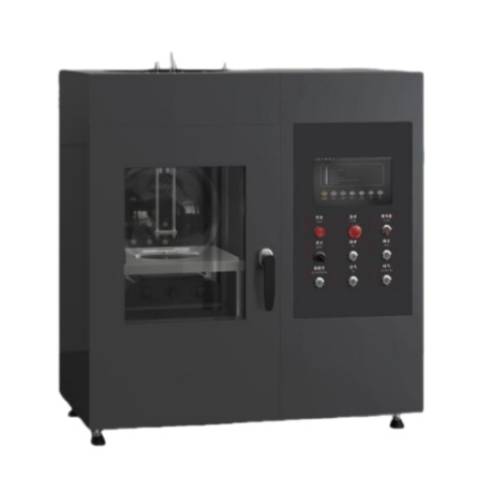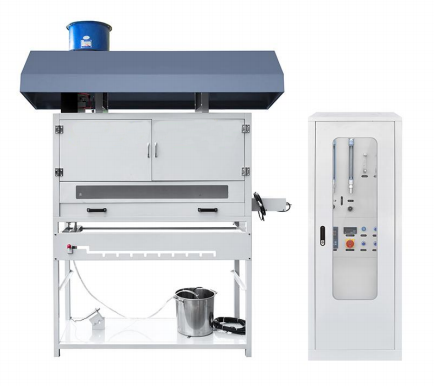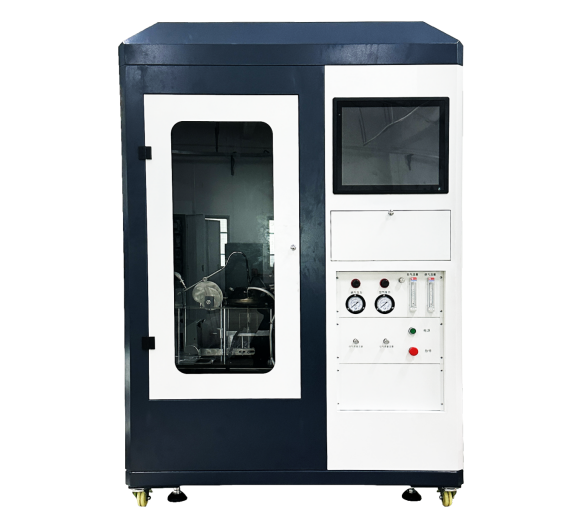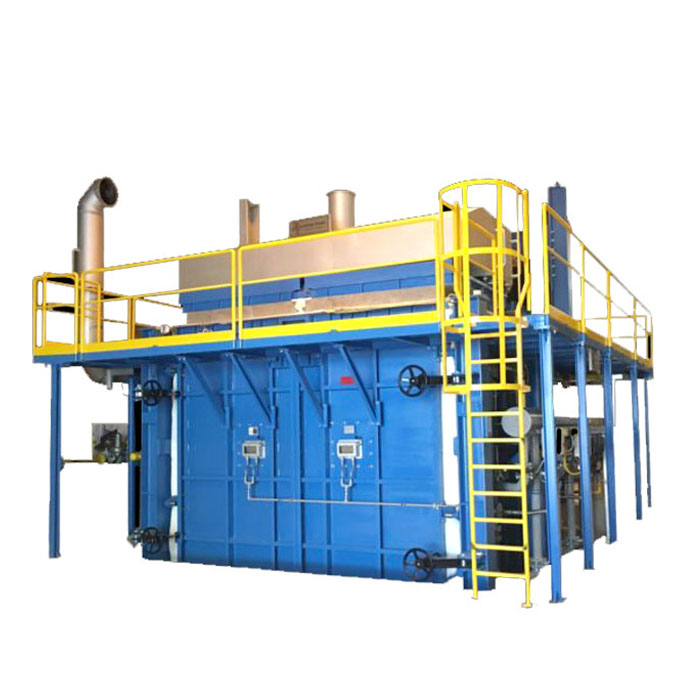
Horizontal Fire Resistance Test Furnace
Category:Material Combustion Tester

Introduction
The Horizontal Fire Resistance Test Furnace for Building Elements is designed for fire resistance testing of horizontal building components under controlled thermal exposure. Manufactured in accordance with GB/T 9978.1-2008. this furnace provides stable and uniform fire conditions to evaluate the fire resistance performance of load-bearing and non-load-bearing horizontal structural elements.
The system simulates standard fire curves and records temperature, pressure, and combustion behavior throughout the test, making it suitable for laboratories involved in building fire safety evaluation, material certification, and structural fire performance research.
Application
Building Fire Resistance Testing
Fire resistance evaluation of horizontal structural elements such as floors, slabs, roofs, and horizontal partitions.
Structural Engineering and Construction Materials
Testing of concrete slabs, steel floor systems, composite structures, and protected steel assemblies under standard fire exposure.
Fire Protection Materials
Performance testing of fireproof coatings and fire-resistant treatments applied to horizontal load-bearing components.
Fire Safety Research and Certification
Fire endurance testing to support compliance verification, safety assessment, and technical research.
Standards
The furnace complies with the following standards:
(1) GB/T 9978.1-2008 – Fire Resistance Tests — Elements of Building Construction — Part 1: General Requirements
(2) ISO 834-1 – Fire Resistance Tests — Elements of Building Construction — Part 1: General Requirements
(3) GB/T 9978.3-2008 – Fire Resistance Tests — Elements of Building Construction — Part 3: Commentary on Test Methods and Test Data Application
(4) GB/T 9978.5-2008 – Fire Resistance Tests — Elements of Building Construction — Part 5: Specific Requirements for Loadbearing Horizontal Separating Elements
(5) GB/T 14907-2018 – Test Standard for Fire Protective Coatings for Steel Structures
Parameters
| Item | Specification |
|---|---|
| Number of Burners | 12 proportional flat-flame burners (6 on each side, 5 m furnace length) |
| Operating Temperature | Maximum test temperature 1250 °C |
| Design Temperature | 1350 °C |
| Combustion Mode | Low-speed proportional flat-flame diffusion combustion |
| Gas & Air Pressure | ≤ 4000 Pa |
| Flame Length | ≤ 500 mm |
| Furnace Temperature Measurement Points | 9 points |
| Thermocouple Sleeve Extension | ≥ 25 mm |
| Temperature Accuracy | < ±15 °C |
| Furnace Pressure Measurement | T-type probes, accuracy ±2 Pa, 3 points |
| Data Acquisition Rate | 3 times per second |
| Fuel Gas | Liquefied petroleum gas |
| Equipment Dimensions | 8 m (W) × 8 m (L) × 2.5 m (H) |
| Power Supply | AC 380 V, 70 kW |
| Equipment Weight | Approx. 5 t |
Features
Robust Furnace Structure
Frame-type enclosure with refractory bricks and high-temperature insulation fiber ensures thermal stability while minimizing heat loss to the surrounding environment.
Safe and Accessible Operation Design
Steel platforms are installed around the furnace for convenient operator access and maintenance.
Advanced Combustion Safety Protection
Automatic flame-out detection with visual and audible alarms; the system cuts off LPG supply to the affected burner while other burners continue operating.
Reliable Gas Supply and Control System
Equipped with gas solenoid valves, proportional valves, pressure transmitters, ball valves, regulators, and filters to ensure stable and safe gas delivery.
Precise Air–Fuel Ratio Control
Combustion air is supplied by a dedicated blower with frequency inverter for airflow adjustment, ensuring optimal combustion conditions.
Independent Control System
Dedicated control components manage combustion processes and simulate standard fire curves accurately.
Automatic Temperature Curve Tracking
Real-time comparison between actual furnace temperature and the preset fire curve, with automatic correction via burner output adjustment.
Comprehensive Data Recording
All automatic control and test data are stored in the computer system for traceability and accuracy verification.
Accessories
(1) Proportional flat-flame burners
(2) Gas solenoid valves and proportional valves
(3) Combustion air blower with frequency inverter
(4) Gas pressure regulators and filters
(5) T-type furnace pressure probes
(6) High-temperature exhaust fan with inverter
(7) Programmable logic controller (PLC) system
(8) Computer-based control and data acquisition system
Maintenance Information
Inspect burners, gas valves, and pipelines regularly to ensure proper operation and safety.
Check temperature and pressure sensors periodically and verify measurement accuracy.
Clean refractory surfaces and exhaust ducts to prevent residue buildup.
Ensure the exhaust fan and combustion air blower operate smoothly.
Back up test data and control records to maintain traceability.
FAQ
1. What types of building elements can be tested using this furnace?
This furnace is designed for fire resistance testing of horizontal building elements, including floors, slabs, roofs, and horizontal partitions. It is particularly suitable for load-bearing and separating components that must maintain structural integrity and insulation performance during fire exposure in accordance with GB/T 9978 and ISO 834 requirements.
2. How does the furnace control and maintain the standard fire temperature curve?
The system uses a computer-controlled PLC to continuously compare the actual furnace temperature with the preset standard fire curve. When deviations occur, the control system automatically adjusts burner output by regulating gas flow and combustion air supply. This closed-loop control ensures that the furnace temperature closely follows the required fire curve throughout the entire test duration.
3. What safety measures are integrated into the combustion system?
The furnace is equipped with flame-out detection, sound and light alarms, automatic gas shutoff for failed burners, pressure relief devices, and explosion protection systems. These measures ensure safe operation during high-temperature fire resistance testing.
4. What type of fuel gas is used for testing?
The furnace uses liquefied petroleum gas as the combustion fuel, providing stable and controllable heat output suitable for long-duration fire resistance tests.
If you're ready to take the next step, Leave your message below and we’ll reply soon. 20+ years of manufacturing & export experience, a partner you can trust.