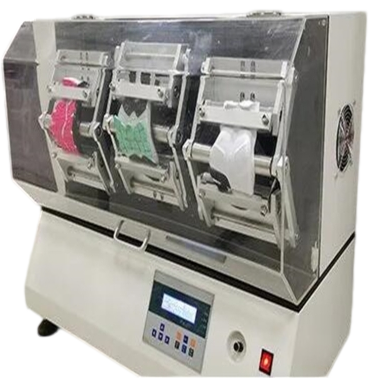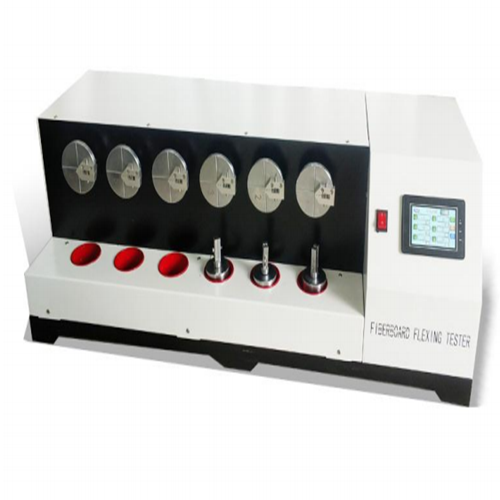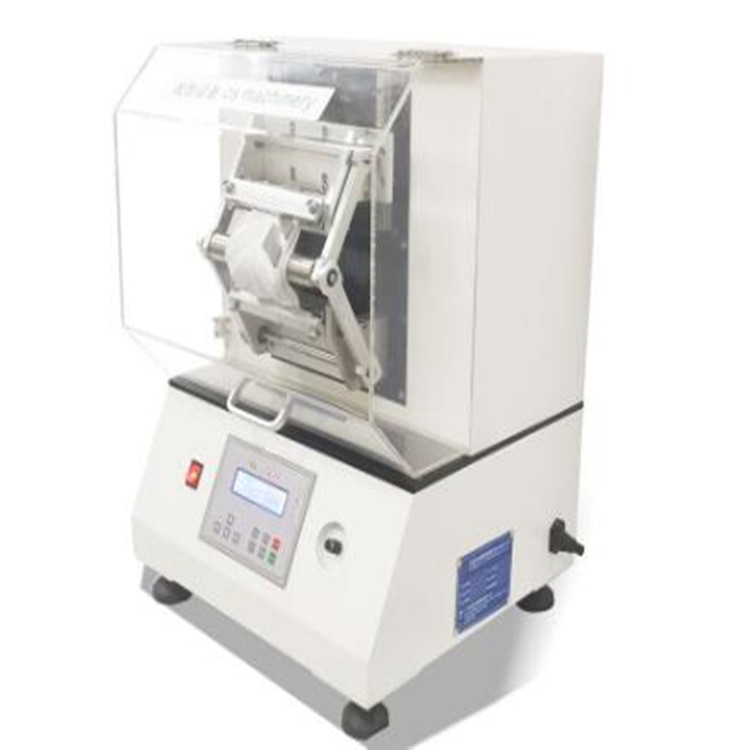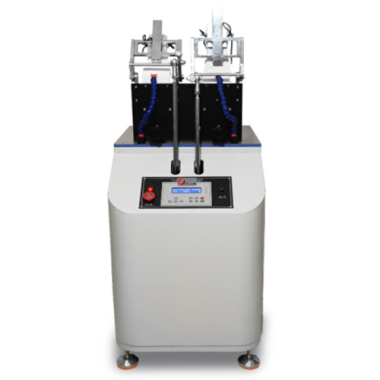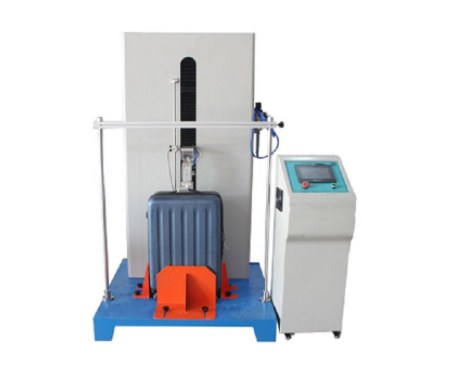
Luggage Rod Reciprocating Fatigue Tester
Category:Flexing & Fatigue Tester

Introduction
Luggage rod reciprocating testing machine for luggage rod reciprocating fatigue test. In the test, the specimen will be stretched to test the gap generated by the tie rod, loosening, connecting rod failure, deformation, etc.
Application
Leather suitcase trolley reciprocating fatigue testing machine is used to test fatigue of the reciprocating rod for the luggage. During the test, the rod would be stretched and then test whether there will be backlash, loose, connecting problems and transformation of the rod.
Standards
QB/T 2919-2010:Test method for fatigue resistance of luggage trolley handles
Technical Parameters
| Technical Parameter | Specification |
|---|---|
| Test travel | 20——100cm, adjustable |
| Maximum drawing speed | 0——10 cm/sec, adjustable |
| Maximum compression speed | 0——10 cm/sec, adjustable |
| Test times | 0——999999 times (automatic stop) |
| Test power component | Power cylinder |
| Sensing position | Four-point sensing position |
| Maximum height of specimen | 100cm |
| Auxiliary equipment | Case fixing clamp |
| Operating pressure | 5——8kg/cm² |
| Machine size (W×D×H) | 80×90×180cm |
| Machine weight | About 120kg |
| Power supply | AC220V, 50/60Hz, 5A |
Features
1. Targeted Testing: Specifically designed for reciprocating fatigue testing of luggage pull handles, it can accurately detect core failure problems such as increased clearance, loose components, connecting rod failure, and structural deformation that commonly occur during the use of pull handles.
2. Compliant with Industry Testing Standards: Although the design basis is stated as QB/T2919-2010 (Note: there is no officially published information for this version), it actually matches the current QB/T 2919-2018 “Luggage Pull Handle Fatigue Test Method,” and the testing logic is consistent with industry standard requirements, providing professional reference value for the results.
3. High Scene Fidelity: Through reciprocating tensile testing, it simulates the actual use state of the pull handle during daily extension and retraction, more realistically reflecting the long-term durability of the pull handle.
4. Wide Range of Applications: It can cover various luggage products with retractable pull handles (such as suitcases, trolley cases, etc.), and is adaptable to the testing needs of different specifications of pull handles.
Accessoriess
(1)Sample clamp holder: adjust the test size
(2)pull rod holder
(3)Rod movement device: do reciprocating motion ,and the speed and travel can be adjustable
(4)support frame:the height is not less than 1500 mm, Install pulling, pressing travel guide
(5)pull rod lock switch gear
(6)counter:count the movement times
FAQ
1. What is the primary purpose of this machine?
It evaluates the durability and fatigue resistance of luggage telescopic rods by simulating repeated extension and retraction cycles.
2. Which types of products can be tested?
The machine is suitable for telescopic handles used in suitcases, travel bags, and other luggage products.
3. How does the machine operate?
The luggage rod is mounted in the tester, and the machine automatically performs reciprocating extension and retraction cycles while monitoring for mechanical failure or deformation.
4. Which standards does this tester comply with?
It typically complies with international luggage durability standards such as ISO 12402. ASTM F2100. and other industry-specific testing protocols.
5. Who typically uses this equipment?
Luggage manufacturers, quality control laboratories, and R&D teams use it to ensure the reliability of telescopic handles and improve product longevity.
If you're ready to take the next step, Leave your message below and we’ll reply soon. 20+ years of manufacturing & export experience, a partner you can trust.