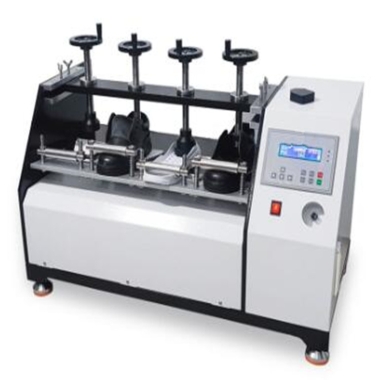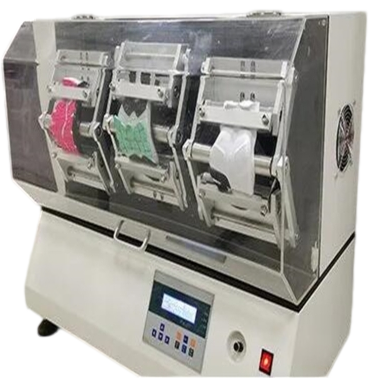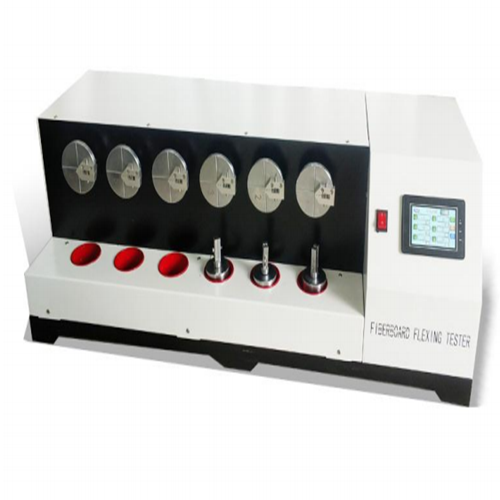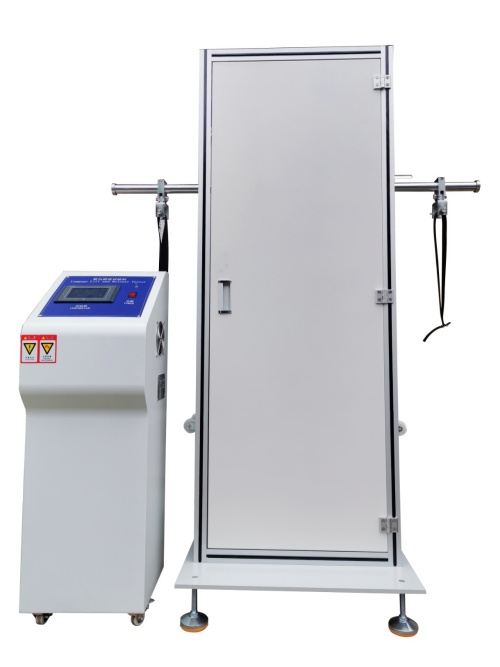
Luggage Simulation Lifting and Unloading Tester
Category:Flexing & Fatigue Tester

Introduction
The luggage simulation lifting and unloading tester is a measuring instrument for the life of the handle of the luggage carrier. It is one of the important equipment for testing the performance and quality of luggage products. Product data can be used as a standard reference for judging the performance of luggage and can be used as an important basis for buyers to select bags.
Application
1.Handle strength test: Simulates repetitive impact under carrying conditions to detect the risk of stitching failure.
2.Overall structure test: Verifies the deformation of the case frame through cyclic testing to optimize material selection and structural design.
3.Component durability test: Evaluates the reliability of key components such as the pull rod and wheels during long-term use.
Standards
QB/T 1586.3:Hardware fitting of case and bag – Case-handle
Technical Parameters
| Technical Parameter | Specification |
|---|---|
| Lifting height | 0-300mm adjustable, eccentric drive convenient stroke adjustment |
| Amplitude | 0——10cm adjustable |
| Speed | 0-30 times adjustable |
| Test weights | 5kg, 10kg each |
| Counting quantity | Display 0——999999 times (can be set counting stop) |
| Transmission motor | Variable frequency motor |
| Power supply | 1 #, 220V/50HZ |
| Machine volume | 150014001800mm |
| Machine weight | About 120kg |
Features
Made of high-quality cold-rolled steel plate with high-temperature baking paint treatment, it is aesthetically pleasing and easy to clean and maintain.
It uses a variable frequency motor drive, ensuring stable running speed, low noise, and high stability.
The sample fixture is made of imported aluminum profiles, which are lightweight, have a smooth surface, and are rust-proof.
The equipment features an imported silk-screened panel with silicone buttons, providing sensitive operation and durability.
It uses a color touchscreen for operation and display.
Accessoriess
1. Drive System
The system uses a motor drive to achieve reciprocating motion through a crank-connecting rod or telescopic cylinder mechanism. The stroke adjustment accuracy is ±1mm, ensuring the stability of the lifting and lowering movements.
2. Vibration Mechanism
It consists of a sleeve, a movable shaft, and a compression spring. Some models utilize a patented T-shaped slider and groove structure to reduce friction loss and improve testing efficiency.
3. Clamping Device
Equipped with adjustable left/right clamping hooks, it features an automatic locking function through a locking plate and a clamping plate, supporting the secure fastening of bags of different sizes and ensuring that the test specimen does not fall off during testing.
4. Control and Display System
Touchscreen controller: Integrates functions for setting test speed, number of cycles, load, and other parameters, and supports real-time data monitoring and storage.
LCD digital counter: High-precision display of the number of test cycles, with an error of ≤±1 cycle.
Safety protection: Photoelectric sensors monitor the specimen status in real time, and the machine automatically stops in case of detachment, preventing equipment damage.
FAQ
1. What is a Luggage Lifting and Unloading Testing Machine?
The Luggage Lifting and Unloading Testing Machine is a device designed to simulate repeated lifting, lowering, and unloading of luggage. It evaluates the durability of handles, straps, and overall luggage construction under realistic usage conditions.
2. How does the machine simulate real-world handling?
The machine repeatedly lifts and lowers luggage with adjustable weights, speed, and height to mimic passenger handling, conveyor belt transfers, and storage scenarios. This helps identify weak points in handles, zippers, and structural design.
3. What types of luggage can be tested?
It can test various types of luggage, including suitcases, travel bags, backpacks, and carry-on bags of different sizes, materials, and weights. Adjustable clamps and platforms allow versatile testing.
4. What parameters are measured during testing?
The machine measures fatigue life of handles and straps, structural deformation, latch and zipper durability, and failure points under repeated lifting and unloading cycles. Some models provide data logging and visual reports.
5. Why is luggage lifting and unloading testing important?
This testing ensures luggage can withstand repeated handling without breaking or deforming. It improves product quality, reduces warranty claims, and enhances customer confidence in luggage durability.
If you're ready to take the next step, Leave your message below and we’ll reply soon. 20+ years of manufacturing & export experience, a partner you can trust.