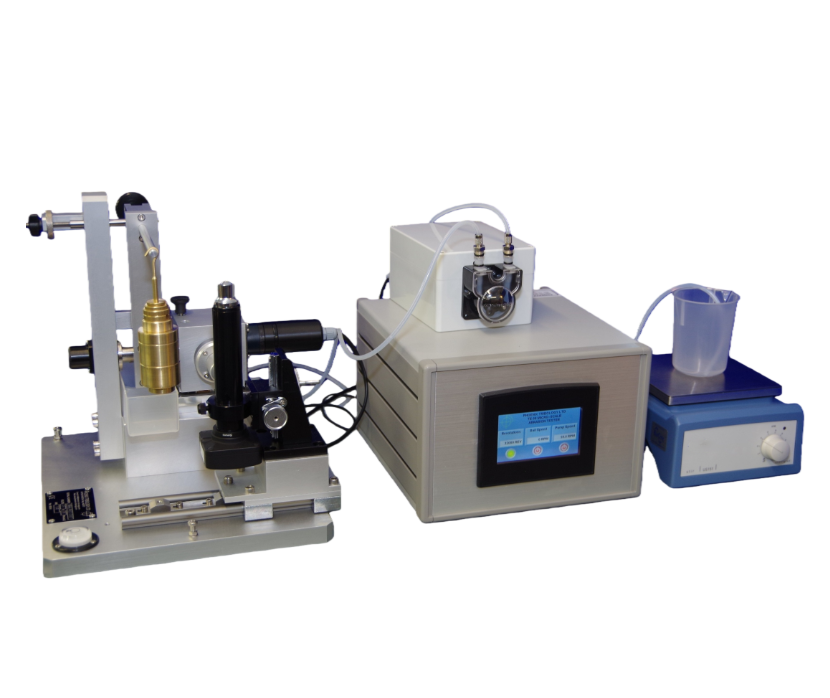
Micro-Scale Abrasion Tester
Category:Abrasion Tester
Factory Direct
Stable Performance
Intl. Standards
Tech Support
Fast Delivery
Global Shipping

Introduction
The Micro-Scale Abrasion Tester is a laboratory instrument used to evaluate abrasive wear behavior of hard coatings, soft coatings, and monolithic materials using a controlled ball-on-plate contact configuration. You can use this system to determine wear coefficients under micro-abrasion conditions and to generate controlled wear craters for accurate coating thickness measurement. The tester provides precise control of load, rotational speed, and test cycles, ensuring repeatable and standardized wear testing results.
Application
You can use this tester in the following application scenarios and test objects:
Coating wear resistance evaluation: PVD coatings, CVD coatings, thermal spray coatings, ceramic coatings
Coating thickness determination: thin film and functional coatings on metal or ceramic substrates
Material research: ceramics, metals, polymers, and surface-treated materials
Tribology studies: micro-scale abrasive wear mechanism analysis
Quality control: coating consistency verification and process validation
Academic and research laboratories: teaching experiments and wear modeling studies
Standards
BS EN 1071-6 — Advanced Technical Ceramics – Methods of Test for Ceramic Coatings – Determination of Abrasion Resistance by Micro-Abrasion Wear Test
Parameters
| Item | Specification |
|---|---|
| Contact configuration | Ball-on-plate |
| Ball diameter | 25 mm |
| Ball speed range | 30 – 150 rpm |
| Load range | 0.05 – 5 N |
| Abrasive supply | Slurry-fed |
| Slurry feed rate | Up to 60 ml/hour |
| Load application | Counterbalanced beam with pivot |
| Speed control | Manual set-point via touch interface |
| Cycle measurement | Integrated revolution counter |
| Wear observation | Integrated digital microscope |
| Camera resolution | 5 MP CMOS USB camera |
| Optical magnification | ×3 and ×5 |
| Power supply | 220/240 V, single phase, 50 Hz, 120 W or 110/120 V, single phase, 60 Hz, 120 W |
| Installation type | Bench-mounted |
| Machine dimensions | 720 × 440 × 570 mm |
| Cabinet dimensions | 530 × 420 × 320 mm |
| Net weight | 25 kg |
| Gross weight | 50 kg |
Features
Precisely defined normal load independent of friction conditions
Clamped ball design ensures accurate speed and cycle control
Wide load range without the need for changing ball sizes
Stable and repeatable abrasive slurry delivery using a peristaltic pump
Integrated digital microscope enables in-situ crater measurement
Suitable for both wear coefficient calculation and coating thickness determination
Compact bench-mounted design for laboratory environments
Accessories
(1) Standard ball specimen (25 mm diameter)
(2) Abrasive slurry delivery system
(3) Peristaltic pump with tubing
(4) Digital microscope with USB camera
(5) Waste slurry collection tray
(6) Optional laboratory magnetic stirrer for slurry agitation
(7) Optional line-contact adapter for block-on-ring configuration
Maintenance Information
You should regularly clean the ball, specimen holder, slurry feed lines, and waste tray to prevent contamination.
Inspect bearings, shafts, and pivot points for smooth operation.
Check the peristaltic pump tubing for wear and replace when necessary.
Calibrate speed control and optical measurement systems periodically.
Disconnect power before performing maintenance or component replacement.
FAQ
(1) What is this product?
It is a laboratory wear testing instrument used to evaluate micro-scale abrasive wear and coating thickness.
(2) What is this product used for?
You use it to determine wear coefficients of coatings and materials and to measure coating thickness through controlled crater formation.
(3) What is the working principle of this product?
A rotating ball abrades the specimen surface in the presence of an abrasive slurry, producing a measurable wear crater under a precisely controlled load.
(4) Why is this product important?
It provides a low-cost, accurate, and repeatable method for assessing coating durability and thickness without destructive sectioning.
(5) Which industries is this product suitable for?
It is suitable for surface engineering, ceramics, materials research, coating manufacturing, quality control, and academic research laboratories.
If you're ready to take the next step, Leave your message below and we'll reply soon. 20+ years of manufacturing & export experience, a partner you can trust.