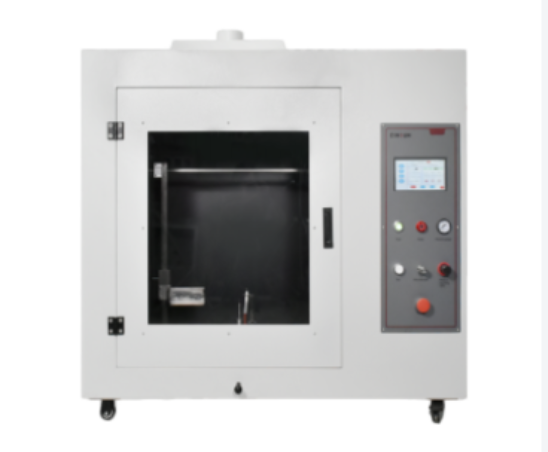
Needle Flame Tester
Category:Flammability Tester

Introduction
The needle flame test uses a needle-shaped burner of a specified size (0.9 mm), supplied with a specific gas (butane or propane), to apply a flame to the test specimen at a 45° angle for a set duration. The flammability risk of small flames caused by fault conditions within the equipment is assessed based on whether the specimen and the ignition support layer ignite, the duration of combustion, and the length of the flame.
Application
The needle flame tester is widely used in various fields, including but not limited to the following applications:
Electrical and electronic equipment: Used to evaluate the flame retardant performance of electrical and electronic products, ensuring the safety of equipment under abnormal conditions.
Household appliances: Used to test the flame retardant performance of materials inside household appliances, ensuring home safety.
Building materials: Used to evaluate the flame retardant performance of building materials, ensuring the safety of building structures.
Automotive interior parts: Used to evaluate the flame retardant performance of automotive interior parts, ensuring safety inside the vehicle.
Aerospace materials: Used to evaluate the flame retardant performance of aerospace materials, ensuring flight safety.
The needle flame tester assesses the flammability risk of materials by simulating small flames under fault conditions. It complies with international and domestic standards and is an important tool for improving product fire safety performance and ensuring personal and property safety.
Standard
GB/T 5169.5: Electrical & Electronic Equipment – Needle Flame Test Method
IEC 60695-11-5/IEC 60695-2-2: Fire Hazard Testing – Needle Flame Test Apparatus
IEC 60745-1/IEC 60335-1: Safety of Handheld Motor-Operated Tools & Household Appliances
IEC 60950-1/IEC 60598-1/IEC 60065: IT Equipment, Luminaires, & Audio/Video Safety
Advantages
Realistic Fault Simulation: Mimics small flames (≤12mm) from internal equipment faults using a 45° angled needle burner.
Precision Compliance: Meets IEC/GB standards for electrical product safety certification.
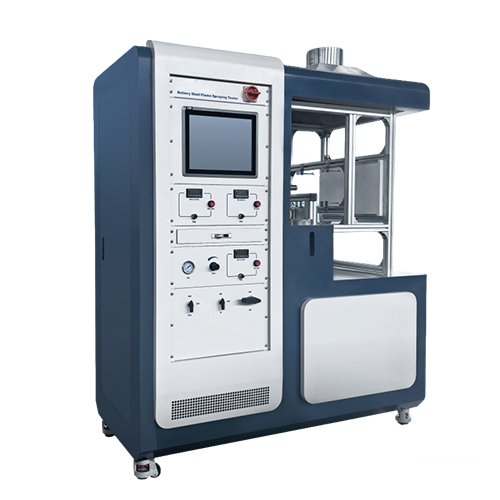
Automated Control: PLC + touchscreen for flame height adjustment, timing, and data logging.
High-Accuracy Flame: Stainless steel burner (Φ0.5±0.1mm) with butane/propane fuel for stable ignition.
Safety First: Auto-exhaust system and flame height calibration prevent operational risks.
Multi-Material Testing: Evaluates insulation materials, engineering plastics, and solid combustibles.
Features
Needle Burner Design: Φ0.5mm inner hole, 45° tilt angle for precise flame application.
Smart Touch Interface: Programmable control of combustion time (0–999.9s), flame height (12±1mm), and gas flow.
Flame Calibration: Auto-measures temperature rise (100°C→700°C in 23.5±1.0s) with K-type thermocouple.
Sample Bed: White pine board (10mm) + silk paper layer for realistic ignition testing.
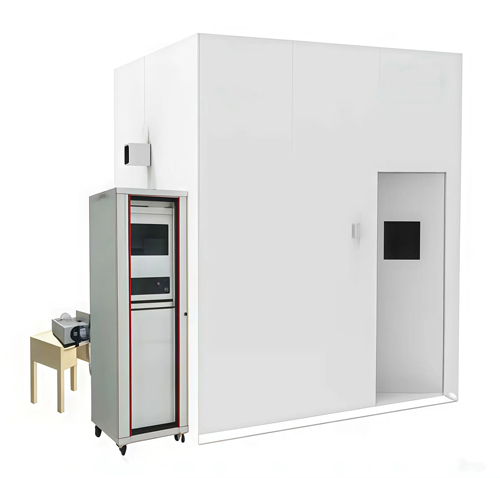
Large Chamber: >0.5 m³ (customizable to 0.75/1 m³) with black background (<20 Lux).
Exhaust System: 100mm diameter pipe with silent anti-backflow design.
Technical Parameters
| Parameter | Specification |
|---|---|
| Burner Specs | Stainless Steel; Inner Φ0.5±0.1mm; Outer Φ0.9mm; Length >35 mm |
| Flame Angle | Vertical (Calibration) / 45° (Test) |
| Combustion Gas | 95% Butane/Propane |
| Flame Temperature | 100–700°C (Rise Time: 23.5±1.0s) |
| Test Time | 0–999.9s (Adjustable; Default: 30s) |
| Burning Time Recording | 0–9999s (Automatic) |
| Chamber Volume | >0.5 m³ (900×590×1050 mm); Custom Options: 0.75/1 m³ |
| Exhaust Pipe | Φ100 mm |
| Control System | PLC + 7-inch Touchscreen |
| Dimensions (W×D×H) | 1120 × 520 × 1250 mm |
| Net Weight | 80 kg |
| Power Supply | AC 220V ±10%, 50Hz |
| Temperature Range | 0–1000°C (K-Type Thermocouple) |
FAQ
1. What is the purpose of the needle flame test?
It evaluates the ignition risk and flame resistance of electrical products and materials under small flame exposure, simulating fault conditions.
2. What gas is used for the needle flame test?
Typically, 95% butane gas is used, supplied by the user.
3. Can the flame height and duration be adjusted?
Yes. Both flame height and application/hold time are adjustable for precise testing.
4. Are there safety measures for gas leaks?
Yes. The optional gas alarm system can detect leaks and trigger alarms. Automatic gas shut-off is also included.
5. Can this device be used for all materials?
It is suitable for solid materials and electrical components. Liquids or specimens that cannot be fixed in the holder are not suitable for this test.
If you're ready to take the next step, Leave your message below and we’ll reply soon. 20+ years of manufacturing & export experience, a partner you can trust.