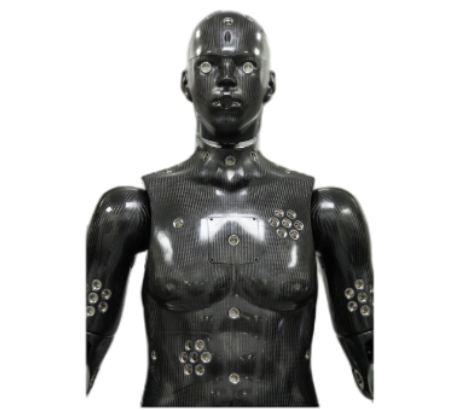
Porton Thermal Manikin Equipment
Category:Manikin System
Introduction
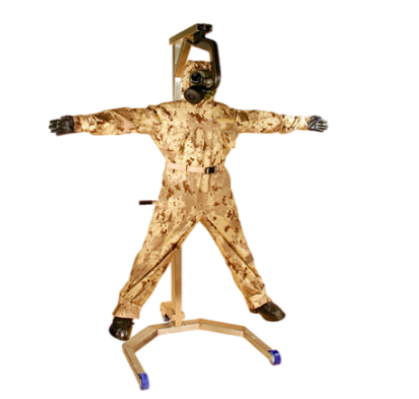
Porton-man was commissioned by the Defense Science and Technology Laboratory (DSTL) to accurately represent military users. This is a state-of-the-art robotic model designed for the UK Armed Forces to test Chemical and biological (CB) protective clothing and equipment.
The porton-man is computer-controlled, and when connected to its drive frame, it can walk like an infantryman, travel (at 0.5 m/s to 1 m/s), run, sit (at 2 m/s to 3 m/s), kneel, climb stairs and raise its arms as if seeing a weapon. More than 100 sensors throughout the body can record data during testing, allowing scientists to perform real-time analysis.
Application
The Porton-man Thermal Manikin is suitable for a wide range of applications, including:
(1) Military Protective Clothing Testing: Evaluates the thermal, barrier, and comfort performance of CB protective suits, gloves, and boots.
(2) Chemical and Biological Defense Research: Tests the efficacy of garments and equipment against chemical and biological hazards.
(3) Product Development & Quality Control: Assesses new designs of protective clothing and materials under realistic motion and environmental conditions.
(4) Human Factors & Ergonomics: Studies the impact of movement, posture, and exertion on wearer comfort and mobility.
(5) Third-Party Laboratory Testing: Supports certification, regulatory compliance, and performance verification of protective equipment.
Standard:
The instrument is designed and tested in compliance with the following international and national standards:
(1) KSF ISO 12949 – Protective clothing testing methods for chemical and biological agents
(2) ASTM E459-22 – Standard test method for thermal manikins
(3) ISO 12949-2011 – Protective clothing—Manikin-based evaluation
(4) ASTM E457-08 (2020) – Thermal manikin calibration and performance
(5) ASTM D6616-21 – Standard practice for testing full-body protective clothing
(6) BS 10/30207740 DC – UK military protective clothing standard
(7) ASTM E598-08 (2020) – Thermal manikin measurements
(8) ASTM D4683-25 – Evaluating barrier properties of protective fabrics
Capabilities and Simulation:
The porton-man is computer-controlled, and when connected to its drive frame, it can walk like an infantryman, travel (at 0.5 m/s to 1 m/s), run, sit (at 2 m/s to 3 m/s), kneel, climb stairs and raise its arms as if seeing a weapon. This range of motion allows the robot to realistically simulate a variety of infantry movements and tasks, including locomotion at different speeds, changes in posture, and actions involving the upper body. This dynamic capability is crucial for evaluating how protective clothing performs during physical exertion and complex movements, which can impact its protective barrier, thermal comfort, and overall wearability.
Data Acquisition and Analysis:
More than 100 sensors throughout the body can record data during testing, allowing scientists to perform real-time analysis. These numerous sensors likely measure various parameters relevant to the performance of the protective gear and the simulated physiological responses of a human wearer. Data such as temperature, humidity, pressure differentials, and potentially mass transfer or agent penetration can be collected in real-time as the robot performs its movements. This extensive data allows for detailed analysis of the protective system’s performance under specific, controlled dynamic conditions.
Key Aspects:
Accurate Human Representation: Designed to replicate the physical characteristics and movement patterns of military personnel.
Specialized for CB Gear Testing: Specifically built to evaluate the effectiveness of protective clothing and equipment against chemical and biological agents.
Dynamic Movement Simulation: Capable of performing a wide range of realistic infantry movements.
Extensive Data Collection: Equipped with over 100 sensors for detailed monitoring during tests.
Real-time Analysis: Enables immediate processing and interpretation of collected data.
State-of-the-Art Technology: Represents a high level of robotic and testing technology.
Technical Parameters
| Parameter | Specification |
|---|---|
| Type | Computer-controlled robotic manikin |
| Primary Function | Testing chemical and biological protective clothing and equipment |
| Movement Capabilities | Walk, travel, run, sit, kneel, climb stairs, raise arms |
| Travel Speed | 0.5 m/s – 1 m/s |
| Run/Sit Speed | 2 m/s – 3 m/s |
| Sensor Count | >100 sensors distributed throughout the body |
| Data Recording | Real-time recording during testing |
| Analysis Capability | Immediate processing and evaluation of collected data |
| Control | Computer-controlled with integrated drive frame |
| Dimensions | Customizable according to test configuration |
| Weight | Dependent on configuration |
Features
Type: Computer-controlled robotic mannequin.
Primary Function: Testing Chemical and Biological (CB) protective clothing and equipment.
Movement Capabilities: Walk, travel, run, sit, kneel, climb stairs, raise arms.
Sensor Count: More than 100 sensors throughout the body.
Data Recording: Capable of recording data during testing.
Analysis Capability: Allows for real-time analysis of collected data.
Maintenance Information
(1) Regularly inspect mechanical joints, actuators, and sensors for wear.
(2) Calibrate sensors and data acquisition modules according to manufacturer recommendations.
(3) Clean surfaces and mechanical components using non-corrosive agents.
(4) Avoid exposure to extreme temperatures or moisture that could damage electronics.
(5) Maintain logs of test sequences, calibration, and maintenance activities.
(6) Ensure software updates are applied to control and analysis systems for optimal performance.
FAQ
1. What is Porton Man used for?
Porton Man is a full-size intelligent anthropomorphic testing system used to evaluate the protective performance of chemical, biological, and CBRN protective clothing and equipment under realistic dynamic human motion conditions. It is suitable for research, development, certification, and comparative testing.
2. What types of protective clothing can be tested?
The system can test airtight and non-airtight chemical protective suits, biological and anti-infection suits, CBRN full protective systems (including masks and respirators), emergency response gear, and industrial chemical protective clothing.
3. How does the system simulate human motion?
Porton Man uses a computer-controlled driving system to perform dynamic movements such as walking, marching, running, sitting, kneeling, and climbing stairs. This allows testing under conditions that closely replicate real-world human activity.
4. How is protective performance measured?
The robot is equipped with over 100 distributed sensors covering key body areas. Sensors collect real-time data on pressure, leakage, and other parameters, enabling a quantitative and comprehensive evaluation of suit integrity and overall system protection.
5. How does Porton Man ensure safety and repeatability?
By using a robot instead of human subjects, all tests avoid exposure to chemical or biological hazards. The system provides high repeatability, controlled test conditions, and consistent data collection, ensuring reliable evaluation of protective gear.