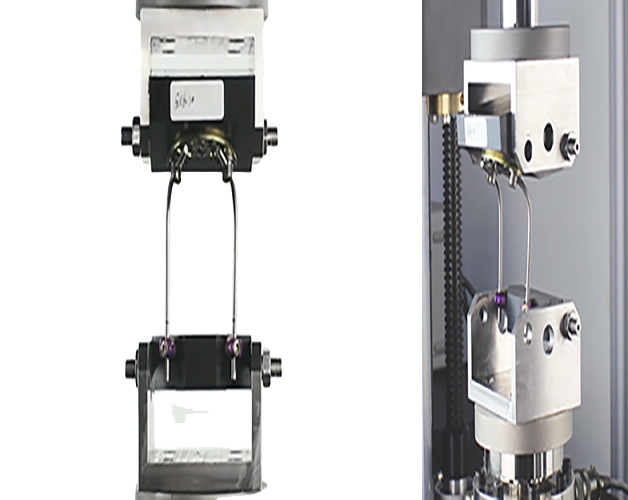
Spinal Pedicle Screw-Rod System Torsional Fatigue Testing Machine
Category:Medical Device Tester
Factory Direct
Stable Performance
Intl. Standards
Tech Support
Fast Delivery
Global Shipping

Introduction
The Spinal Pedicle Screw-Rod System Torsional Fatigue Testing Machine is a specialized device used to evaluate the torsional fatigue performance of spinal implant systems, specifically pedicle screws and connecting rods.
Standards
YY/T 0857. YY/T 1560. ASTM F1717. ASTM F2706
These standards define the materials and methods for static and fatigue testing of spinal implants in vertebral resection models, including cervical and cervicothoracic implant assemblies. Fatigue tests are performed at a frequency of 5 Hz, R = -1. for 5 million cycles or until specimen failure.
Application
The Spinal Pedicle Screw-Rod System Torsional Fatigue Testing Machine is used to evaluate the mechanical durability and torsional fatigue performance of spinal fixation systems under repeated rotational loads. Typical applications include:
Orthopedic implant testing: Assess torsional strength and fatigue life of pedicle screw-rod constructs.
Quality control: Verify consistency and mechanical reliability of manufactured spinal fixation systems.
Research and development: Support design optimization and material selection for spinal implants.
Standards compliance: Conduct tests according to ISO 12189. ASTM F1717. and other international spinal implant testing guidelines.
This machine ensures spinal fixation devices can withstand cyclic torsional loads in vivo, reducing the risk of implant loosening or failure.
Technical Specifications
| Parameter Category | Parameter | Specification |
|---|---|---|
| Axial | Maximum load peak | 4000 N |
| Dynamic load peak | 4000 N | |
| Static load peak | 2100 N | |
| Load measurement range | 0.4%–100% F.S. | |
| Load measurement accuracy | ±0.2% of reading | |
| Maximum loading frequency | 2 Hz | |
| Axial stroke | 70 mm | |
| Displacement resolution | 0.1 μm | |
| Torsion | Maximum dynamic torque | 30 N·m |
| Torque measurement range | 0.4%–100% F.S. | |
| Torque measurement accuracy | ±0.2% of reading | |
| Maximum torsional loading frequency | 10 Hz | |
| Rotation angle range | unlimited | |
| Maximum rotational speed | 150 r/min | |
| Angular resolution | 0.018° | |
| General | Test space (vertical clamp distance) | 0–950 mm |
| Net weight | ~600 kg | |
| Dimensions | ~1170 × 700 × 2650 mm | |
| Optional Fixtures | Spinal rod/screw torsion fixtures, fusion device torsion fixtures, orthopedic screw tension-torsion fixtures, tapered fit strength test fixtures, femoral head torsion fixtures, etc. | |
| Applications | Dynamic and static torsion testing of surgical implants (e.g., intervertebral fusion devices), combined tension-torsion tests, single-axis tension/compression tests. |
Features
Equipped with an imported torque motor, providing high servo precision and seamless integration of axial and torsional actuation, delivering up to 5 kN axial load and 20 N·m torque, suitable for various material tests.
Hydraulic assist system allows easy crossbeam lifting, locking, and specimen clamping, making test operations efficient and convenient.
High-precision imported torsion sensors combined with zero-backlash ball screws achieve load and torque measurement accuracy of ±0.5% of reading or ±0.05% of full scale (whichever is better).
Supports single-axis tension/compression, pure torsion, and combined tension-torsion control modes, enabling tensile, compressive, bending, shear, creep, and relaxation tests.
Accessories
(1)Specimen Fixtures: Secure pedicle screw-rod constructs for torsional testing.
(2)Rotational Actuator: Applies controlled cyclic torsional loads.
(3)Data Acquisition System: Records torque, angular displacement, and fatigue cycles.
(4)Calibration Tools: Ensure accurate torque and rotation measurements.
Maintenance Information
Daily Cleaning: Wipe fixtures, sensors, and actuators to remove debris and residues.
Calibration: Periodically calibrate torque sensors and rotational actuators.
Inspection: Check for wear or damage on mechanical components and sensor connections.
Lubrication & Storage: Lubricate moving parts if necessary and store in a clean, dry environment.
FAQ
1. What is the main function of this machine?
It evaluates the torsional fatigue performance and durability of pedicle screw-rod spinal fixation systems under repeated rotational loads.
2. What types of specimens can be tested?
Standard spinal pedicle screw-rod constructs, assembled according to ISO 12189. ASTM F1717. or equivalent guidelines.
3. How does it simulate real-world conditions?
The machine applies cyclic torsional loads that mimic the rotational stresses experienced by spinal implants in vivo.
4. Which standards does it comply with?
Supports ISO 12189. ASTM F1717. and other international standards for spinal implant torsional fatigue testing.
5. How is maintenance performed?
Regular cleaning of fixtures and sensors, calibration of torque and rotation systems, inspection for wear or damage, and proper storage in a clean, dry environment.
If you're ready to take the next step, Leave your message below and we'll reply soon. 20+ years of manufacturing & export experience, a partner you can trust.