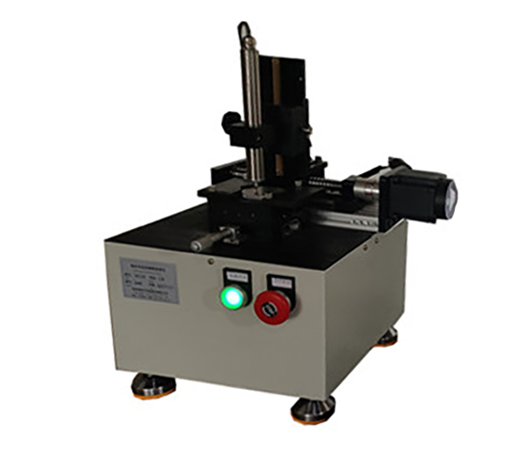
Wear Track Profilometer
Category:Abrasion Tester
Factory Direct
Stable Performance
Intl. Standards
Tech Support
Fast Delivery
Global Shipping

Introduction
A wear profiler is a device used to measure the characteristics of worn surfaces, providing high-precision wear rate measurements. It provides reliable data for selecting the optimal material by accurately measuring the wear condition of coatings or substrate materials.
Application
The probe type material surface abrasion measuring instrument is a kind of high precision measuring equipment, its main purpose is to accurately measure and analyze the abrasion marks formed by the friction grinding test on the material surface. Specifically, the main uses of the device include:
Abrasion depth and width measurement: The probe type material surface abrasion measuring instrument can automatically measure the depth and width of the abrasion, providing accurate numerical results. It is of great significance to evaluate the wear resistance of materials, optimize the material design and improve the test conditions of friction and wear.
Wear mark topography analysis: The device can graphically display the two-dimensional outline of the wear mark, and intuitively characterize the wear condition and wear resistance of the material surface. This helps researchers gain a deeper understanding of the mechanisms and processes of friction and wear.
Data storage and report generation: The probe type material surface abrasion meter has a data storage function to save test data for subsequent analysis and comparison. At the same time, the device can also automatically generate test reports, which is convenient for users to organize and archive test results.
Material development and optimization: In the process of material development, the equipment can be used to select materials with excellent wear resistance, providing a scientific basis for material selection and optimization design
Standards
(1)ASTM G99-17:Standard Test Method for Wear Testing with a Pin-on-Disk Apparatus
(2)ISO 25178-2:2012:Geometrical product specifications (GPS) — Surface texture: Areal — Part 2: Terms, definitions and surface texture parameters
(3)GB/T 12444-2006:Metallic materials – Wear test method – Block-on-ring sliding wear test
(4)ISO 20808:2016:Fine ceramics (advanced ceramics, advanced technical ceramics) — Determination of friction and wear characteristics of monolithic ceramics by ball-on-disc method
(5)GB/T 17754-2016:Friction and wear testing—Terminology
Parameters
| Description | Details |
|---|---|
| Abrasion scanning method | Automatic |
| Longitudinal resolution of scanning probe | 0.02μm |
| Wear test force range | ≦40g |
| Longitudinal measurement range of scanning probe | ±0.5mm (Measurement range can be changed according to the user’s requirements) |
| X-axis travel range | 0~50mm |
| Y-axis travel range | 0~25mm |
| Z-axis travel range | 0~50mm |
| Size of sample tray | Φ76mm |
| Dimensions of the main body of the instrument | 230300260 |
| Weight of main body of the instrument (Kg) | 10 |
Feature
The wear profiler is characterized by high precision, high stability, high repeatability, and an intelligent management and testing software system. These features ensure that the wear profiler can meet the measurement accuracy requirements of the workpiece and provide accurate wear behavior analysis and evaluation.
Accessoriess
Interference objective, light source, optical zoom, etc.
FAQ
1. What is a Wear Track Profilometer?
A Wear Track Profilometer is a precision measurement device used to analyze the surface profile and geometry of wear tracks on materials after friction or abrasion testing. It helps quantify wear depth, volume, and surface roughness.
2. How does the wear track measurement work?
The device scans the worn area using contact or non-contact methods (e.g., stylus or optical sensors) to record a high-resolution profile of the wear track. Data is used to calculate wear depth, cross-sectional area, and wear volume.
3. What types of materials can be analyzed?
It can analyze metals, polymers, ceramics, composites, coatings, and lubricated or unlubricated surfaces from tribological or abrasion tests.
4. What parameters are measured?
The profilometer measures wear depth, wear volume, cross-sectional area, surface roughness, and track width. Some models also provide 3D surface mapping for detailed wear morphology analysis.
5. Why is wear track profilometry important?
Profilometry provides quantitative data on material loss and surface degradation, allowing engineers to evaluate material performance, optimize coatings, and compare tribological behaviors under different conditions.
If you're ready to take the next step, Leave your message below and we'll reply soon. 20+ years of manufacturing & export experience, a partner you can trust.