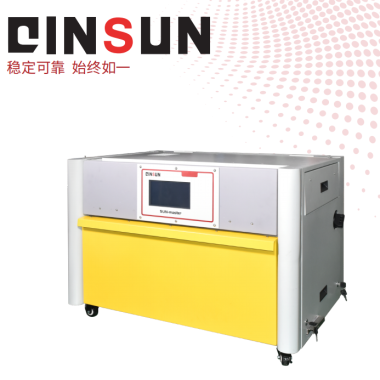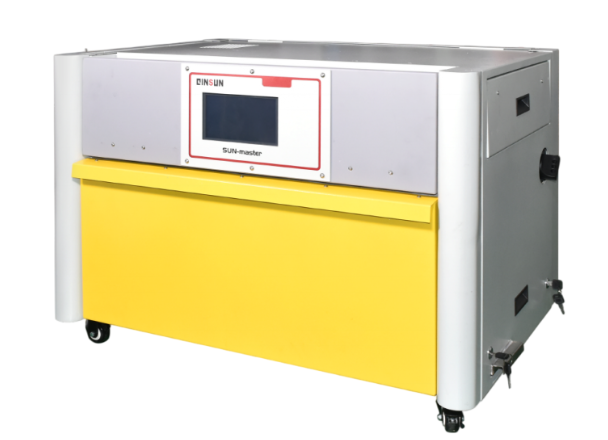
7.5kW Xenon Weather Meter
Category:Xenon Test Chamber
Introduction
The GX75 7.5kW Xenon Weather Meter is a high-performance accelerated aging system designed to artificially reproduce the complex stresses of both indoor and outdoor environments. By utilizing a powerful 7.5kW water-cooled xenon arc lamp, this instrument simulates sunlight, temperature, humidity, and rainfall to accelerate the degradation of materials and predict their operational lifespan. Whether you are performing standard durability tests or advanced ultra-accelerated research, the GX75 provides the precision and irradiance control required to evaluate material performance with global consistency.
Applications
7.5kW Xenon Weather Meter is designed to artificially reproduce indoor and outdoor environments such as sunlight, temperature, humidity, and rainfall, accelerating the aging of products and materials to predict their service life. The product range spans from global standard weathering testers to the latest premium accelerated models.
Standards
The GX75 meets stringent international standards, including:
ISO 4892-2. ASTM G155. SAE J2527 (automotive coatings)
JIS K7350-2 (Japan Industrial Standard for weathering tests)
AATCC TM16. GB/T 16422.2 (China’s national standard for xenon-arc exposure)
These standards ensure reliable evaluation of material durability, colorfastness, and aging resistance.
Parameters
| Parameter | Specification |
|---|---|
| Light Source | 7.5kW water-cooled xenon arc lamp |
| Irradiance Control | 40–120 W/m² (300–400 nm), auto-calibration |
| Temperature Range | BPT 63–110°C ±2°C, chamber 38°C ±2°C |
| Humidity Range | 50% RH ±5% RH (light cycle), 95% RH ±5% RH (dark cycle) |
| Spray System | Programmable surface/back spray for rain simulation |
| Sample Capacity | Up to 63 samples (70×150 mm) |
| Filter Options | Daylight (#295), Extended UV (#275), Window Glass (#320) |
| Dimensions | 1030×1270×1850 mm (W×D×H), 500 kg |
Features
High-Intensity Acceleration: The 7.5kW water-cooled lamp allows for significantly higher irradiance levels than air-cooled systems, enabling you to finish life-cycle predictions in a shorter timeframe.
Versatile Simulation Cycles: You can program complex cycles that include light exposure, dark periods, rainfall (front spray), and evening dew (rear spray) to replicate real-world diurnal variations.
Superior Irradiance Control: The system maintains precise control over the 300–400nm range, ensuring that the spectral distribution remains consistent even as the lamp ages.
Dual-Spray Functionality: Unique spray configurations allow for moisture simulation on both the front and back of the samples, which is critical for assessing materials prone to delamination or backside corrosion.
Wide Temperature Range: With a BPT capability up to $110^\circ\text{C}$, you can simulate the extreme heat found on automotive dashboards or in desert climates.
Accessories
Xenon Arc Lamp: 7.5kW high-output water-cooled lamp.
Filter Set: Interchangeable inner (Quartz) and outer (#295. etc.) filters to match specific solar spectra.
Black Panel Thermometer (BPT): For precise surface temperature monitoring.
Specimen Holders: Standard stainless steel clips for $150 \times 70\text{mm}$ samples.
Water Cooling Unit: Dedicated heat exchanger system to maintain lamp temperature.
Irradiance Calibration Meter: For periodic verification of the xenon output.
Test Procedures
1. Preparation and Calibration
Inspect the xenon lamp and filters for any signs of aging or residue. Use the calibration meter to verify the irradiance settings. Ensure the cooling water system is running with high-purity deionized water.
2. Sample Installation
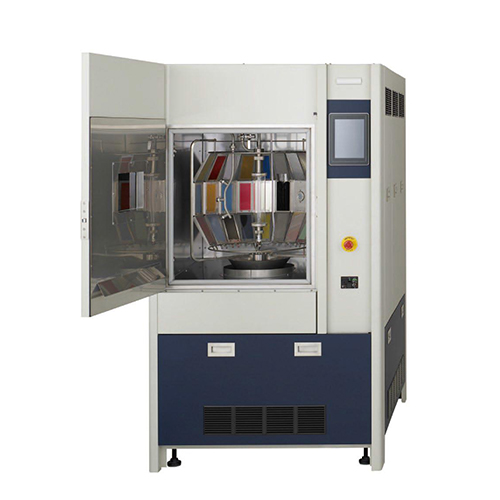
Secure your specimens into the holders. Position them on the rotating drum, ensuring that all 63 slots are either filled with samples or blanking plates to maintain uniform airflow and temperature distribution.
3. Initiating the Test
Start the test sequence. The sample drum will begin rotating around the central xenon lamp to ensure equal exposure. The system will automatically switch between spray and dark modes as programmed.
4. Data Recording and Assessment
Monitor the real-time logs for BPT and irradiance stability. Once the cycle is complete, remove the samples and evaluate them for color change, gloss loss, or physical degradation compared to your control specimens.
FAQ
1. How does the GX75 ensure long-term irradiance stability during extended tests?
You benefit from a closed-loop irradiance control system combined with automatic calibration. The controller continuously compensates for lamp aging, ensuring that the irradiance in the 300–400 nm range remains within the specified tolerance throughout long-duration exposure cycles.
2. Why is a water-cooled xenon lamp used instead of an air-cooled design?
Water cooling allows the 7.5kW xenon lamp to operate at higher and more stable irradiance levels while effectively removing excess heat. This design reduces thermal drift, improves spectral stability, and supports higher acceleration factors compared with air-cooled systems.
3. Can you test materials that are sensitive to backside moisture or internal delamination?
Yes. The dual-spray system enables independent surface spray and backside spray, allowing you to evaluate materials that are susceptible to moisture ingress, adhesive failure, or backside corrosion under realistic outdoor exposure conditions.
4. How do you control and verify the sample surface temperature during testing?
Sample surface temperature is controlled using a Black Panel Thermometer (BPT). The system maintains BPT within ±2°C of the set value, ensuring repeatable thermal stress conditions that closely match international weathering test standards.
5. Is the GX75 suitable for both standard compliance testing and accelerated research studies?
You can use the GX75 for standard-compliant testing as well as ultra-accelerated aging studies. The wide irradiance and temperature range allows you to run conservative standard cycles or intensified conditions for comparative material screening and R&D validation.