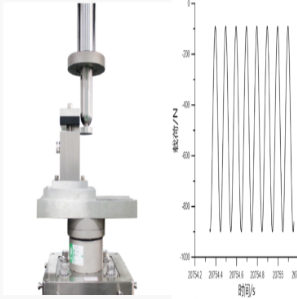
Femoral Stem Neck Prostheses Fatigue Testing Machine
Category:Other
Introduction
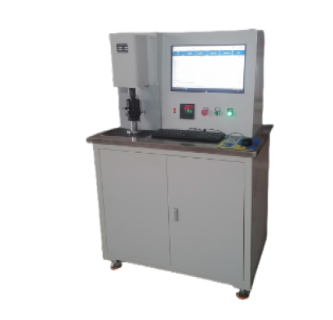
The Femoral Stem Neck Prostheses Fatigue Testing Machine is a precision instrument designed for evaluating the fatigue strength and durability of femoral stem necks used in total or partial hip arthroplasty. It provides reliable, high-cycle testing under simulated physiological conditions, supporting both axial and torsional loads. The system complies with ISO 7206-6, YY/T 0809.6, and ASTM F2023, making it suitable for R&D, quality control, and regulatory testing in orthopedic biomaterials.
Standard
YY/T 0809.6 (China): Specifies neck fatigue testing for femoral stems in partial/total hip arthroplasty.
ISO 7206-6 (International): Defines protocols for evaluating the fatigue strength of femoral head-neck junctions.
ASTM F2023: Additional compliance for dynamic loading of ceramic femoral heads.
Adaptive Protocols: Customizable for emerging standards in biomaterial fatigue testing.
Key Advantages
1. Electromagnetic Precision
M-Series actuator delivers ±0.1% force accuracy with sub-micron displacement control.
Dynamic load control allows programmable waveforms (sine, square, random) from 1–30 Hz.
2. High-Cycle Endurance
Proven capability to complete 10 million cycle tests without drift, meeting ISO 7206-6 fatigue requirements.
Load ratio R=0.1 ensures accurate replication of stress conditions during long-term testing.
3. Real-Time Failure Detection
AI-driven monitoring identifies crack initiation at sub-millisecond intervals.
Integrated high-speed imaging support (optional) enables full-field strain mapping.
4. Ergonomic & Modular Design
15.6” touchscreen with multilingual interface and preloaded SOPs.
Quick-swap environmental chambers allow testing at -20°C to +50°C for accelerated aging or physiological simulation.
5. Safety & Reliability
Emergency stop and overload clutches.
Laser-based specimen breakage detection for immediate shutdown.
Noise level <70 dB (A-weighted).
Technical Parameters
| Parameter | Specification |
|---|---|
| Max. Dynamic Force | ±5,340 N (11,940 N peak optional) |
| Frequency Range | 1–30 Hz (0.1 Hz increments) |
| Load Ratio (R) | 0.1–10 (adjustable) |
| Axial Displacement | ±10 mm (0.1 μm resolution) |
| Torque Capacity | ±50 Nm (0.01 Nm resolution) |
| Temperature Range | -20°C to +50°C (environmental chamber) |
| Data Sampling Rate | 50 kHz (synchronized across 12 channels) |
| Power Requirements | 220V/110V ±10%, 50/60Hz, 1,500 W |
| Dimensions (W×D×H) | 1,200 × 800 × 1,900 mm |
| Weight | 550 kg (including thermal chamber) |
Accessories
1. Femoral Neck Test Fixture Kit
Self-centering collet system (12/14 mm taper compatibility)
Laser-aligned loading anvils with wear-resistant coating
2. Thermal Environmental Chamber
15 L capacity, rapid heating/cooling (10°C/min)
Corrosion-resistant 316L stainless steel interior
3. TestMaster Elite Software
Automated fatigue life prediction (S-N/ε-N curves)
21 CFR Part 11-compliant audit trails with blockchain timestamping
Remote monitoring via iOS/Android
4. Operator Kit
Calibrated torque wrench set (0.5–25 Nm)
Specimen alignment gauges (ISO 7206-6 compliant)
5. Calibration Bundle
NIST-traceable force calibration weights
Temperature verification probe
6. Safety Kit
Laser safety curtains
Acoustic enclosure for noise reduction
FAQ
1. What types of prostheses can be tested?
All femoral stem necks used in partial or total hip arthroplasty, including metal and ceramic femoral heads.
2. How many cycles can the machine perform?
It is designed for 10 million cycle fatigue testing, fully compliant with ISO 7206-6.
3. Can it simulate physiological temperature variations?
Yes, the modular environmental chamber allows testing from -20°C to +50°C, with ±0.5°C stability.
4. How does it detect failure during testing?
AI-driven monitoring combined with laser-based breakage detection identifies crack initiation and full failure in real time.
5. Is the software compliant with regulatory requirements?
Yes, TestMaster Elite Software supports 21 CFR Part 11 audit trails, blockchain timestamping, and remote monitoring for regulatory compliance.