Walk in High and Low Temperature Humidity Test Chamber
Category:Other aging machines
Introduction
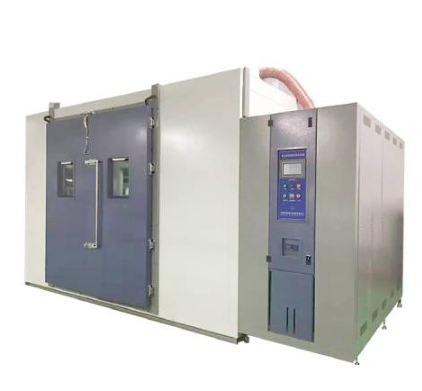
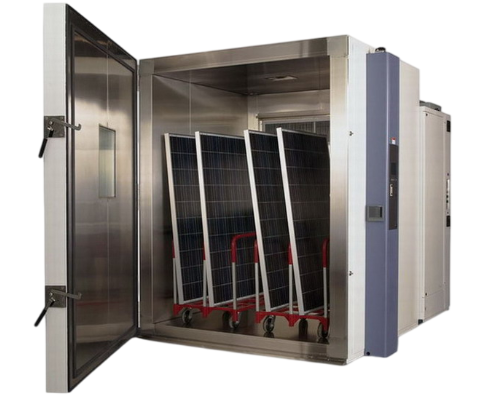
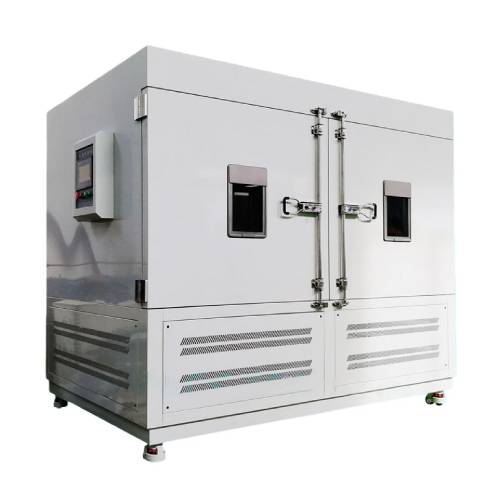
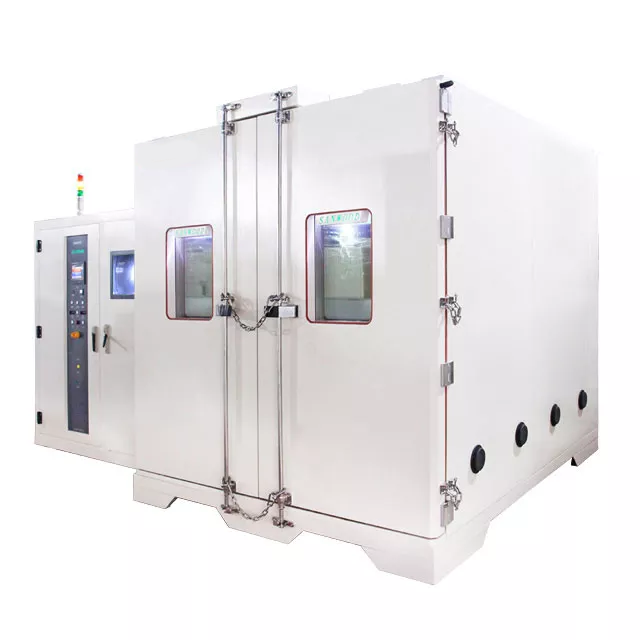
The High and Low Temperature Humidity Test Chamber is a high-performance environmental simulation system specifically engineered for the rigorous testing of EV power batteries. With a massive $12\text{m}^3$ internal capacity, this chamber allows you to evaluate the functional reliability and structural integrity of battery packs under extreme thermal and hygroscopic conditions. Whether you are conducting long-term durability cycles or matching a Battery Management System (BMS) to new cell chemistries, this equipment provides the stable, repeatable environment necessary for precision data acquisition.
Applications
High and Low Temperature Humidity Test Chamber is designed for performance and reliability testing of electric vehicle power batteries. It can be integrated with battery performance testing systems and is also suitable for research and development, matching, and other tests involving power batteries and battery management systems.
Standards
GB/T 2423.1: Environmental testing methods for electrical and electronic products – Test A: Low-temperature test method
GB/T 2423.2: Environmental testing methods for electrical and electronic products – Test B: High-temperature test method
GB/T 2423.3: Environmental testing methods for electrical and electronic products – Constant humidity and heat test method
GB/T 2423.4: Environmental Testing Methods for Electrical and Electronic Products – Alternating Humidity and Heat Test Method
GB/T 10586-2006: Technical Conditions for High and Low Temperature Test Chambers
GB/T 10592-2023: Technical Conditions for High and Low Temperature Test Chambers
IEC 62660-4 Lithium-ion batteries for electric road vehicle propulsion
GB/T 31484-2015 Cycle life requirements and test methods for power batteries used in electric vehicles
Parameters
| No. | Item | Specifications |
|---|---|---|
| 1 | Inner Chamber Volume | 12 m³ |
| 2 | Inner Chamber Dimensions | 3000mm (W) × 2000mm (D) × 2000mm (H) |
| 3 | Temperature Range | -45°C ~ +100°C (adjustable) |
| 4 | Temperature Fluctuation | ≤ 0.5°C (no load, steady state) |
| 5 | Temperature Uniformity | ≤ 2°C (no load, steady state) |
| 6 | Temperature Deviation | ≤ ±2°C (no load, steady state) |
| 7 | Heating Rate | ≥ 2°C/min (room temperature ~ 85°C, with non-linear load of 1000kg battery pack) |
| 8 | Cooling Rate | ≥ 1.0°C/min (room temperature ~ -40°C, with non-linear load of 1000kg battery pack) |
| 9 | Humidity Range | 20% ~ 98% RH (adjustable) |
| 10 | Humidity Deviation | – Humidity > 75% RH: ≤ ±2~3% RH- Humidity ≤ 75% RH: ≤ ±5% RH |
| 11 | Humidity Fluctuation | ≤ 2% RH |
| 12 | Humidity Uniformity | – Humidity > 75% RH: ≤ ±2~3% RH- Humidity ≤ 75% RH: ≤ ±5% RH |
| 13 | Air Pressure Balance System | Equipped with an air pressure balance valve, which opens automatically under a certain pressure difference |
Features
1. Comprehensive Safety Protection: Equipped with explosion-proof devices, automatic fire suppression systems, and gas detection units to ensure testing safety.
2. Intelligent Operation and Energy Efficiency: Supports program control and remote monitoring, utilizes fluorine-free refrigerants and energy-saving technologies, and complies with environmental standards.
Accessories
1.Integrated Fire Suppression: Automatic extinguishing system triggered by thermal or smoke sensors.
2.Gas Detection Sensors: Real-time monitoring for $H_2$, $CO$, and other battery vent gases.
3.Cable Access Ports: Sealed ports (typically $100\text{mm}$) for connecting the battery to external cyclers or BMS testers.
4.Pressure Balance Valve: Mechanical relief valve to equalize internal and external pressure during rapid temperature changes.
5.Multi-Pane Observation Window: Heated glass to prevent frost and condensation during low-temperature or high-humidity runs.
FAQ
1. How does the chamber handle the thermal load generated by the battery during charging and discharging?
The refrigeration system is designed with sufficient excess capacity to compensate for the active thermal load generated by the battery pack. You can specify the expected heat dissipation of the battery in watts, and the chamber dynamically adjusts its cooling output to maintain the programmed temperature setpoint throughout the test.
2. What happens if a battery vents or catches fire during a test?
The chamber is equipped with a blow-out pressure relief port to safely release sudden internal pressure and protect the structural integrity of the system. At the same time, integrated gas and smoke sensors detect electrolyte vapor or combustion byproducts, immediately shutting down the heating system and activating the fire suppression mechanism to mitigate risk.
3. Why is a non-linear load specified for a 1000 kg battery pack?
A battery pack represents a complex thermal mass with uneven heat absorption and release characteristics. Specifying a non-linear load ensures that the chamber can still achieve the rated temperature change rate of 2 °C per minute under realistic conditions. This is critical for meeting stringent automotive validation and development timelines.
4. Can the chamber be integrated with an existing battery cycler?
Yes. The chamber supports integration with most professional battery charging and discharging systems via RJ45 or RS485 communication interfaces. This allows synchronized operation, such as initiating charge or discharge cycles once the chamber reaches a defined temperature soak condition.
5. How is condensation prevented on the battery pack during high-humidity testing?
The air circulation system is designed to maintain stable laminar airflow and precise dew point control. By optimizing temperature ramp-down rates and internal air distribution, the system minimizes the risk of condensation forming on sensitive areas such as high-voltage terminals and connectors.
6. Does the chamber support fast change rate testing?
The standard configuration supports a temperature change rate of at least 2 °C per minute with a 1000 kg load. For applications requiring faster ramp rates, the chamber can be customized with higher-capacity refrigeration systems to meet specific testing standards, including certain MIL-STD or OEM-defined requirements