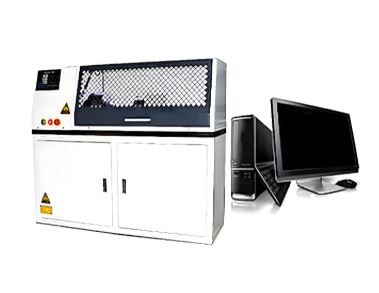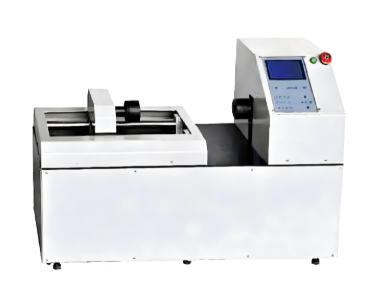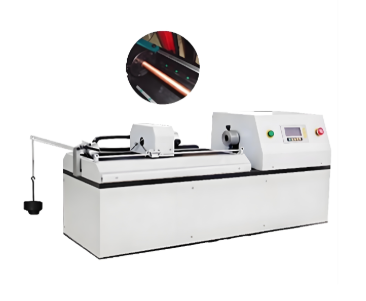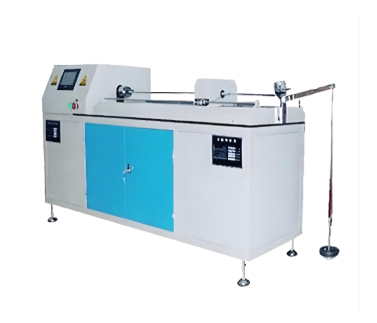
Carbon Fiber Composite Core Torsion Testing Machine
Category:Torsion Testing Machine
Factory Direct
Stable Performance
Intl. Standards
Tech Support
Fast Delivery
Global Shipping
Introduction
The Carbon Fiber Composite Core Rod Torsion Testing Machine is designed to evaluate the ability of metal and non-metal wires or rods to withstand plastic deformation during unidirectional or bidirectional torsion. It can also reveal surface and internal defects in the test specimen.
Applications
Unidirectional Torsion:
The specimen is uniformly rotated around its own axis in one direction until the specified number of turns is reached or the specimen fractures.
Bidirectional Torsion:
The specimen is uniformly rotated around its own axis in one direction for a specified number of turns and then rotated in the opposite direction for the same number of turns or until fracture occurs.
The wire torsion testing machine is suitable for determining the ability of metal wires with a diameter or characteristic dimension of 0.1–14 mm to withstand plastic deformation under unidirectional or bidirectional torsion, while also identifying surface and internal defects.
Applicable Materials
The machine can be used for a wide range of metal and non-metal wire materials, including:
Steel Wires: Fine steel wires and other steel wire materials
Copper Wires: Copper wires, copper alloys, etc.
Aluminum Wires: Aluminum wires, aluminum alloys, etc.
Other Materials: Fiberglass-reinforced materials, ultra-fine fibers, alloy steel and other applicable materials
It can also be configured for testing carbon fiber composite core rods according to specific specimen dimensions and test requirements.
Applicable Standards
The Carbon Fiber Composite Core Rod Torsion Testing Machine can be designed to comply with the following national and international standards:
GB/T 239.1-2012 — Metallic Materials — Wire — Part 1: Test Method for Torsion Test
GB/T 239.2-2012 — Metallic Materials — Wire — Part 2: Test Method for Reverse Torsion Test
GB/T 239-1999 — Metallic Materials — Wire — Torsion Test Method
ISO 7800:1984 — Metallic Materials — Wire — Simple Torsion Test
ISO 9649:1990 — Metallic Materials — Wire — Reverse Torsion Test
Main Technical Specifications
| Parameter | Specification |
|---|---|
| Applicable Metal Wire Diameter | Φ1–Φ14 mm |
| Gauge Length Between Chucks | 550 mm |
| Maximum Counting Capacity | 9999.9 turns |
| Speed Error | <±5% |
| Minimum Turn Count Resolution | 0.1 turn |
| Chuck Hardness | 55–65 HRC |
| Guide Rail Parallelism | <0.2 mm |
| Chuck Coaxiality | <Φ0.4 mm |
| Approx. Test Bench Weight | 220 kg |
| Power Supply | 220 V, 50 Hz |
| Protection Functions | Overcurrent and overvoltage protection |
Customized Complete Testing Solutions
Complete testing systems for wire materials can be customized according to customer requirements, including:
Wire Torsion Testing Machine
Wire Wrapping Testing Machine
Wire Tensile Testing Machine
The equipment can be supplied individually or as a complete wire testing system, depending on the material, specimen dimensions, testing method, and applicable standards.
If you're ready to take the next step, Leave your message below and we'll reply soon. 20+ years of manufacturing & export experience, a partner you can trust.