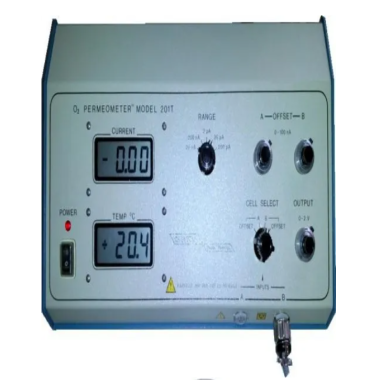
Contact Lens Oxygen Permeability Tester
Category:Other
Factory Direct
Stable Performance
Intl. Standards
Tech Support
Fast Delivery
Global Shipping

Introduction
The Contact Lens Oxygen Permeability Tester (Polarography Method) is a precision instrument designed to measure the oxygen permeability (Dk) of soft and hard contact lenses, hydrogel, silicone hydrogel, and other high oxygen permeability materials. The instrument provides accurate, repeatable measurements critical for lens manufacturers, laboratories, and research institutions. A complete measurement setup typically includes the main host, electrode assembly frame, electrodes, central thickness gauge, and a controlled temperature and humidity environment, ensuring compliance with international and national standards.
Application
(1) Measurement of oxygen permeability of soft contact lenses (hydrogel, silicone hydrogel).
(2) Evaluation of oxygen permeability in rigid or hard contact lenses.
(3) Quality control of contact lenses in manufacturing facilities.
(4) Research and development of new lens materials with enhanced oxygen permeability.
(5) Verification of compliance with regulatory standards for ophthalmic products.
(6) Laboratory testing of lens prototypes for performance evaluation.
Standards
(1) ISO 18369 – Ophthalmic optics – Contact lenses – Requirements and test methods.
(2) GB/T 11417 – Contact lens oxygen permeability measurement.
(3) ANSI Z80.20 – American National Standard for Contact Lens Oxygen Permeability.
(4) ISO 9913-1 – Ophthalmic materials – Oxygen permeability of polymer materials.
(5) ISO 9913-2 – Ophthalmic materials – Polarographic method for Dk measurement.
Technical Parameters
| Parameter | Specification |
|---|---|
| Dual Input | Supports 2 test electrodes simultaneously |
| Power Supply | 210–250V AC, 5 W |
| Temperature Control | 0.0–50.0°C (Resolution 0.1°C, Accuracy ±0.2°C) |
| Electrode Excitation Voltage | 0.750 VDC |
| Electrode Specifications | Gold cathode Ø4 mm; Silver anode inner Ø5.75 mm, outer Ø12.75 mm |
| Size (W×D×H) | 356 × 190 × 102 mm |
| Current Zero Adjustment | 0–100 nA |
| Current Measurement Gears | 19.99 nA (±10 pA), 199.9 nA (±100 pA), 1.999 μA (±1 nA), 19.99 μA (±10 nA), 199.9 μA (±100 nA) |
Features
(1) Dual input design supports simultaneous measurement of two test electrodes.
(2) Polarographic measurement ensures high accuracy and reproducibility.
(3) Compatible with soft, hard, hydrogel, silicone hydrogel, and other high Dk lenses.
(4) Complete system integration with host, electrode assembly, central thickness gauge, and temperature/humidity control.
(5) Precision temperature control (0.0–50.0°C) with 0.1°C resolution and ±0.2°C accuracy.
(6) Adjustable electrode excitation voltage (0.750 VDC) for polarographic measurements.
(7) Current measurement range with multiple gear options for low- and high-permeability lenses.
(8) Compact and portable design suitable for laboratory use.
Accessories
(1) Electrode assembly frame with two electrode slots.
(2) Gold cathode and silver anode electrodes.
(3) Central thickness gauge for accurate lens measurement.
(4) Constant temperature and humidity chamber.
(5) Calibration and adjustment tools.
(6) User manual and compliance certificates.
Maintenance Information
(1) Clean electrodes and assembly frame after each test to prevent contamination.
(2) Periodically calibrate the instrument using standard reference lenses.
(3) Check temperature and humidity control systems regularly for accuracy.
(4) Avoid exposure of the instrument to direct sunlight or high humidity.
(5) Replace electrodes when worn or damaged to maintain measurement precision.
(6) Store the instrument in a dry and dust-free environment when not in use.
FAQ
1. What is the primary purpose of this tester?
It measures the oxygen permeability (Dk) of contact lens materials, indicating how much oxygen can pass through the lens to the cornea.
2. Which types of lenses can be tested using this device?
The tester is suitable for soft hydrogel lenses, silicone hydrogel lenses, and rigid gas-permeable lenses.
3. How does the tester operate?
It applies a polarographic or coulometric method to measure oxygen flow through the lens under controlled temperature and humidity conditions.
4. Which standards does this tester comply with?
It supports international standards such as ISO 18369-4 and ISO 9913-1 for contact lens oxygen permeability testing.
5. Who typically uses this equipment?
Contact lens manufacturers, quality control laboratories, and research institutions use it to verify lens safety, optimize materials, and ensure regulatory compliance.
If you're ready to take the next step, Leave your message below and we'll reply soon. 20+ years of manufacturing & export experience, a partner you can trust.