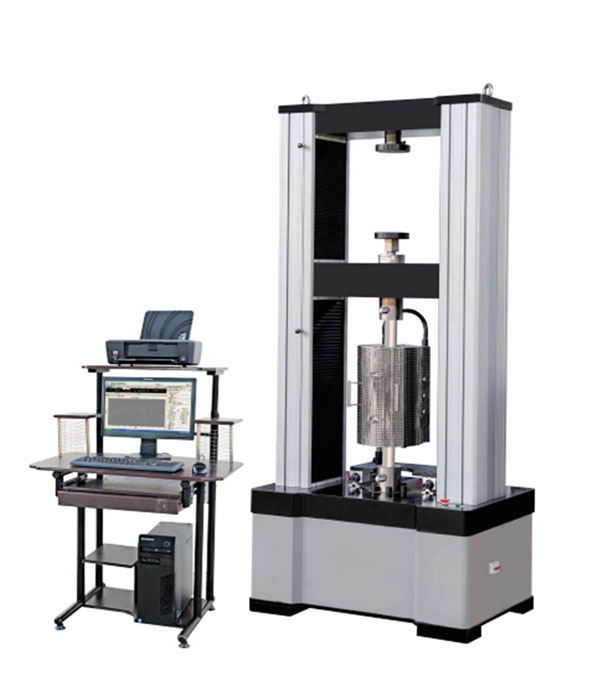
High Temperature Creep Test Machine
Category:Universal Strength Tester
Factory Direct
Stable Performance
Intl. Standards
Tech Support
Fast Delivery
Global Shipping

Introduction
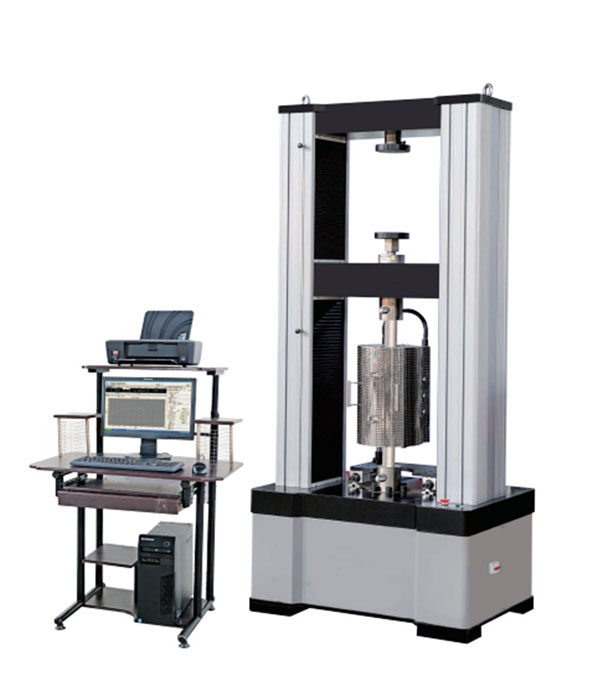
The High Temperature Creep Test Machine is designed for evaluating the long-term creep, endurance, and deformation behavior of materials under constant load and elevated temperature conditions. The system integrates a high-precision mechanical loading unit with a high-temperature electric furnace and digital creep control software to perform accurate tensile creep and endurance tests. It is suitable for metals, non-metals, composite materials, and structural components requiring long-term performance verification in high-temperature environments.
Application
(1) Tensile creep and endurance testing of metallic materials at elevated temperatures.
(2) Long-term creep testing of non-metallic and composite materials under constant load.
(3) Material performance evaluation for aerospace structural components.
(4) High-temperature durability testing for automotive and mechanical parts.
(5) Material research and verification in metallurgical and petrochemical industries.
(6) Academic research and teaching in universities and research institutes.
(7) Quality inspection and certification testing in industrial laboratories.
Standards
(1) ASTM E139 — Standard Test Methods for Conducting Creep, Creep-Rupture, and Stress-Rupture Tests of Metallic Materials
(2) ASTM E292 — Standard Guide for Selection and Installation of Materials for Creep Testing
(3) ASTM D1654 — Standard Test Method for Evaluation of Painted or Coated Specimens Subjected to Corrosive Environments
(4) ASTM C1291 — Standard Test Method for Creep of Ceramic Materials in Compression
(5) ASTM C1337 — Standard Test Method for Creep of Advanced Ceramics in Tension
(6) ASTM D2990 — Standard Test Methods for Tensile, Compressive, and Flexural Creep and Creep-Rupture of Plastics
(7) ASTM D3039 — Standard Test Method for Tensile Properties of Polymer Matrix Composite Materials
(8) ASTM D7337 — Standard Test Method for Compressive Creep of Plastics
(9) ASTM F519 — Standard Test Method for Mechanical Hydrogen Embrittlement Evaluation
(10) BS EN 2002-5 — Aerospace series — Metallic materials — Tensile testing at elevated temperature
(11) BS ISO 8013 — Aerospace — Metallic materials — Tensile testing at elevated temperature
(12) BS 4A4-1 — Aerospace series — Test methods for metallic materials
(13) BS EN ISO 204 — Metallic materials — Uniaxial creep testing in tension
(14) BS EN ISO 899-1 — Plastics — Determination of creep behavior
(15) ISO 903 — Plastics — Determination of creep behavior in tension
(16) MIL-STD-1312 — Fastener Test Methods
(17) NASM 1312 — Aerospace fastener test methods
Parameters
Host Machine
| Item | Specification |
|---|---|
| Maximum testing force | 50 kN |
| Testing accuracy class | 0.5 |
| Force measurement range | 0.4% – 100% FS |
| Force measurement error | ±0.5% |
| Force resolution | 1 / 300000 |
| Coaxiality | ≤10% |
| Deformation measurement error | ±0.002 mm |
| Pulling rod maximum stroke | ≥150 mm |
| Pulling rod speed | 0.01 – 50 mm/min |
| Deformation measurement range | 0 – 10 mm |
| Extensometer resolution | 0.001 mm |
| Extensometer measuring error | ≤2 μm |
| Communication interface | Ethernet (TCP/IP) |
| Power supply | AC 220 V, 50 Hz, 1 kW |
| Host machine weight | 600 kg |
High Temperature Furnace
| Item | Specification |
|---|---|
| Furnace structure | Split three-stage electric heating |
| Furnace body material | Stainless steel 304 |
| Thermal insulation | Ceramic fiber cotton |
| Heating wire diameter | φ1.2 mm |
| Working temperature range | 300 – 1100 ℃ |
| Uniform temperature zone length | ≥150 mm |
| Hearth size | φ80 × 320 mm |
| Temperature fluctuation | ≤ ±2 ℃ |
| Temperature gradient | ≤3 ℃ |
| Furnace shell temperature | ≤90 ℃ |
| Temperature controller accuracy | Class 0.1 |
| Power supply | AC 380 V, 50 Hz, 3 kW |
Features
(1) High-precision constant-load creep testing under elevated temperature conditions.
(2) Knife-edge lever bearing structure providing high sensitivity and stability.
(3) Electric loading system with manual fine adjustment capability.
(4) Automatic leveling system controlled by photoelectric sensors.
(5) Manual leveling function ensuring test stability during power interruption.
(6) Fracture protection mechanism using oil buffering to prevent sudden weight drop.
(7) High-temperature alloy fixtures ensuring long service life and dimensional stability.
(8) Digital PID temperature control ensuring uniform and stable furnace temperature.
(9) Computer-based creep control and long-term testing software with multi-machine monitoring.
Accessories
(1) High-temperature tensile fixtures with upper and lower grips.
(2) High-temperature rod and water-cooled rod assembly (φ10 standard specimen).
(3) Electric furnace suspension and hanging mechanism.
(4) High-temperature specimen extraction device for φ10 samples.
(5) Two high-precision deformation measurement sensors.
(6) Digital PID temperature controller.
FAQ
1. What is this product?
A device that measures the long-term deformation (creep) of materials under constant stress at high temperatures.
2. What is this product used for?
To evaluate creep behavior, deformation rate, and material lifetime for metals, alloys, plastics, and composites under heat and load.
3. How does this product work?
The specimen is clamped, subjected to constant stress, heated to a specified temperature, and the machine records strain over time to generate creep curves.
4. Why is this product important?
It ensures material reliability, supports design and R&D, predicts long-term performance, and prevents high-temperature failures.
5. Which industries is this product suitable for?
Aerospace & aviation
Power generation
Automotive & transportation
Metallurgy & material science
High-temperature industrial manufacturing
Research laboratories and universities
If you're ready to take the next step, Leave your message below and we'll reply soon. 20+ years of manufacturing & export experience, a partner you can trust.