Hydraulic Continuous Fatigue and Tensile Testing Machine
Category:Interior Material Tester
Factory Direct
Stable Performance
Intl. Standards
Tech Support
Fast Delivery
Global Shipping
Introduction
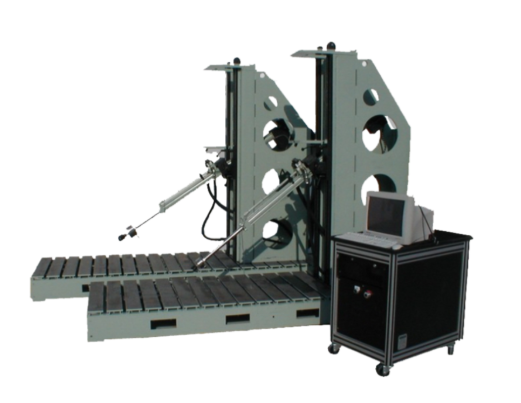
The Hydraulic Continuous Fatigue and Tensile Testing Machine is a dual-function electro-hydraulic servo test system designed to perform either tensile testing or continuous fatigue testing independently. The system is engineered for high-load, long-cycle durability evaluation of components and assemblies, particularly in automotive seating and safety-related applications. Each test station operates independently and is driven by a centralized hydraulic power unit with a dedicated PC-based control and data acquisition system.
Application
This testing machine is widely used for mechanical performance verification of components subjected to repeated loading or static tensile forces, including but not limited to:
Automotive seats and seat structures
Seat rails, seat frames, and adjustment mechanisms
Seat belts, anchors, and fastening components
Interior structural brackets and welded assemblies
Metal and composite structural components
Rubber, polymer, and elastomer fatigue specimens
It is suitable for both laboratory qualification testing and production quality validation in automotive, transportation, and component manufacturing industries.
Standards
The system is designed to meet or support the requirements of the following international and industry-related standards (test methods configurable):
(1) ISO 7500-1 – Metallic materials — Verification of static uniaxial testing machines
(2) ISO 13003 – Fibre-reinforced plastics — Fatigue testing under cyclic loading
(3) ASTM E466 – Standard Practice for Conducting Force Controlled Constant Amplitude Axial Fatigue Tests
(4) ASTM E9 – Compression testing of metallic materials at room temperature
(5) SAE J328 – Fatigue testing of automotive components
(6) SAE J1367 – Seat strength and durability evaluation
(7) GB/T 16825.1 – Verification of static uniaxial testing machines
(8) GB/T 3075 – Axial force-controlled fatigue testing methods
Parameters
| Parameter | Specification |
|---|---|
| Test functions | Tensile test or continuous fatigue test (selectable, not simultaneous) |
| Test stations | Single or multi-station (example shown: 2 stations) |
| Cylinder stroke | 24 inches (610 mm) |
| Cylinder type | Double-rod hydraulic cylinder |
| Maximum capacity per cylinder | Up to 10,000 lbf (≈44.5 kN) |
| Load measurement | Fatigue-rated load cell |
| Displacement measurement | Internal displacement transducer (independent rotation) |
| Mounting structure | Balanced two-axis universal joint mounting |
| Motion freedom | Free movement or lockable in vertical and transverse axes |
| Control system | PC-based independent control and data acquisition |
| Software platform | Windows-based, Visual Basic architecture |
| Hydraulic power unit | Independent, floor-mounted |
| Operating pressure | Workshop hydraulic pressure |
| Power supply | 115 VAC standard (other voltages available) |
Features
Dual-function system capable of performing tensile or continuous fatigue tests independently.
Modular multi-station design allows independent programming and operation of each cylinder.
Electro-hydraulic servo control ensures stable load application and precise waveform control.
Balanced universal joint mounting eliminates misalignment effects during testing.
Large-stroke double-rod cylinders provide uniform load distribution and long fatigue life.
Real-time graphical display of load, displacement, and cycle data.
User-friendly PC software with simple setup and rapid operator learning curve.
Independent hydraulic servo valve and controller for each test station.
Floor-standing control cabinet separates electronics from mechanical vibration sources.
Accessories
(1) Hydraulic test frame with cylinders
(2) Independent hydraulic power unit
(3) PC control and data acquisition system
(4) Fatigue-rated load sensors
(5) Displacement transducers
(6) Universal joint mounting assemblies
(7) Operation and maintenance manual
(8) Calibration certificate
FAQ
1. What is this product?
It is an electro-hydraulic servo testing machine designed for tensile and continuous fatigue testing of components and materials.
2. What is it used for?
It is used to evaluate static tensile strength and fatigue durability under cyclic loading conditions.
3. Why is it important?
It ensures the safety, durability, and reliability of automotive and structural components under real-world loading conditions.
4. Which industries is it suitable for?
Automotive manufacturing, transportation equipment, component suppliers, research laboratories, and quality inspection centers.
5. What types of tests can be performed?
Tensile strength testing, force-controlled fatigue testing, durability evaluation, and fracture-related mechanical testing.
If you're ready to take the next step, Leave your message below and we'll reply soon. 20+ years of manufacturing & export experience, a partner you can trust.