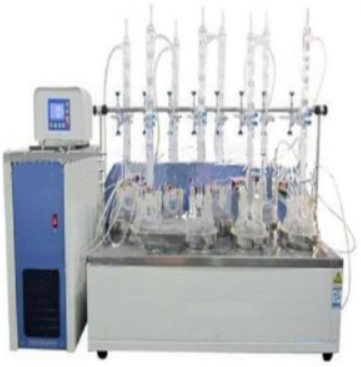
Metal Corrosivity Tester
Category:Other
Factory Direct
Stable Performance
Intl. Standards
Tech Support
Fast Delivery
Global Shipping

Introduction
The Metal Corrosivity Tester is used to determine the corrosivity of liquids and solids that may become liquid during transport. It conforms to the UN Recommendations on the Transport of Dangerous Goods – Manual of Tests and Criteria 37.4. Test Methods for Determining Corrosivity of Metals, and GB 19521.6-2004. Safety Specifications for Testing Hazardous Characteristics of Corrosive Dangerous Goods. The instrument consists of three parts: a display and control unit, a testing system, and a water supply system. It features automatic sample level detection, automatic condensate circulation, and automatic water replenishment for the constant temperature water bath. The testing system is equipped with two sets of testing devices, allowing simultaneous corrosion tests on two different types of samples. Operators can monitor the entire testing process via an LCD screen.
Applications
The metal corrosivity tester is designed and manufactured in line with the requirements stipulated in the national standard of the People’s Republic of China, GB/T21621 Test Method for Metal Corrosivity of Dangerous Goods. It is applicable to the metal corrosivity testing of liquid substances or solid substances that may become liquid during transportation.
Standards
It conforms to the United Nations Recommendations on the Transport of Dangerous Goods – Manual of Tests and Criteria 33.2.1.4 Test N.1: Test Method for Flammable Solids; conforms to GB/T 21618-2008 “Dangerous Goods – Test Method for Burning Rate of Flammable Solids”; conforms to NY/T 1860.15-2010 “Guidelines for Determination of Physicochemical Properties of Pesticides – Part 15: Flammability of Solids”; conforms to GB 5085.4 “Identification Standards for Hazardous Waste – Flammability Identification” 4.2 Flammable Solid Test; conforms to GAT536 “Classification and Test Methods for Fire Hazards of Flammable and Explosive Hazardous Goods”; and conforms to national standards and industry standards that are equivalent or equivalent to the above standards.
Technical Parameters
| Operating environment | (5~40)°C, <85%RH |
| Temperature control range | Room temperature ~ 80°C |
| Temperature control accuracy | ±1°C |
| Temperature uniformity | ±0.5°C |
| Timing range | (0~30)days |
| Timing display resolution | 1min |
| Sample container volume | 3000mL, effective volume 2000mL |
Features
(1)It adopts an embedded processor and Windows CE operating system.
(2)With an 8 – inch liquid – crystal touch screen, it can display the test status in real – time.
(3)It integrates two functions, “sieving experiment” and “combustion rate experiment”, into one.
(4)It is applicable to the detection of two types of sample materials: non – metallic powder and metallic powder.
(5) It is equipped with a standard stacking mold and features a user – friendly shaking handle design.
(6)Strictly in accordance with standard requirements, an ignition torch is used for the sieving experiment, eliminating the need for a gas cylinder and ensuring safety.
(7)A nitrogen rod is used as the ignition source for the combustion rate experiment. The material has high stability, and the ignition source temperature detection device ensures that the ignition temperature reaches above 1000°C.
(8)It uses full – automatic infrared flame detection technology, which can reliably detect open flames and smoldering phenomena, ensuring detection accuracy.
(9)It has a fault – detection function and audible and visual alarm functions to ensure the safety of the experiment.
(10) The experimental process is fully automated, requiring no manual intervention. It supports functions such as parameter setting, data storage, and report viewing.
Accessoriess
(1)Core Working Components
Sample Testing Unit
8-well sample etching tank (suitable for multiple parallel tests): Used to load test liquid/molten solid samples and metal specimens;
Metal specimen fixing bracket: Adaptable to standard specimens (such as steel and aluminum) as required by GB/T 12621. ensuring stable immersion/contact with the sample.
Environmental Control Unit
Compressor – Refrigeration circulating water tank: Supports the condensation system, maintaining a stable test environment temperature;
High-precision temperature sensor (accuracy ±0.5℃): Real-time monitoring of the test tank temperature, matching the temperature control range of “room temperature to 100℃”;
Heating module: Achieves temperature rise and constant temperature control for the test.
Control and Display Unit
Touchscreen display: Used for parameter setting (temperature, duration) and real-time display of test status;
Embedded control module: Supports automated instrument operation and data storage.
(2)Auxiliary Accessories
Sample Processing: Standard metal test pieces (meeting GB/T 12621 material requirements), sample melting and heating device (for easily liquefied solid samples during transportation), pipettes/measuring cylinders (for quantitative liquid dispensing);
Calibration and Maintenance: Temperature calibration standard source, test piece grinding/cleaning tools (sandpaper, anhydrous ethanol, drying oven);
Data Recording: USB flash drive (for exporting test data/reports), test piece weighing balance (accuracy 0.1mg).
Maintenance Information
(1)Routine Inspection: Check all electrical connections, sensors, and sample holders for damage or wear before each test.
(2)Cleaning: After testing, clean the test chamber, electrodes, and sample holders to remove residues and prevent contamination.
(3)Calibration and Safety Checks: Periodically verify sensors and measurement accuracy, and ensure safety interlocks and protective components are functioning properly.
FAQ
1. What is a Metal Corrosivity Tester used for?
It is used to evaluate the corrosive properties of metals when exposed to various liquids, chemicals, or environmental conditions, helping predict material durability and compatibility.
2. Which metals or materials can be tested?
The tester can assess a wide range of metals, alloys, and coated surfaces to determine their resistance to corrosion under controlled laboratory conditions.
3. How does the Metal Corrosivity Tester work?
The device exposes metal samples to specific corrosive environments while monitoring chemical and electrochemical reactions, surface degradation, and corrosion rate over time.
4. What standards does the Metal Corrosivity Tester comply with?
It typically follows international and national standards such as ASTM G31. ISO 9227. or equivalent protocols for standardized corrosion testing.
5. How should the Metal Corrosivity Tester be maintained?
Regular maintenance includes inspecting electrical connections and sensors, cleaning the test chamber and sample holders after each test, and performing periodic calibration to ensure accurate measurements.
If you're ready to take the next step, Leave your message below and we'll reply soon. 20+ years of manufacturing & export experience, a partner you can trust.