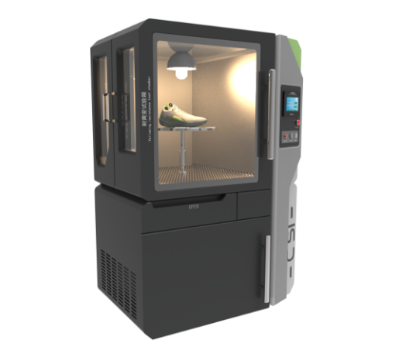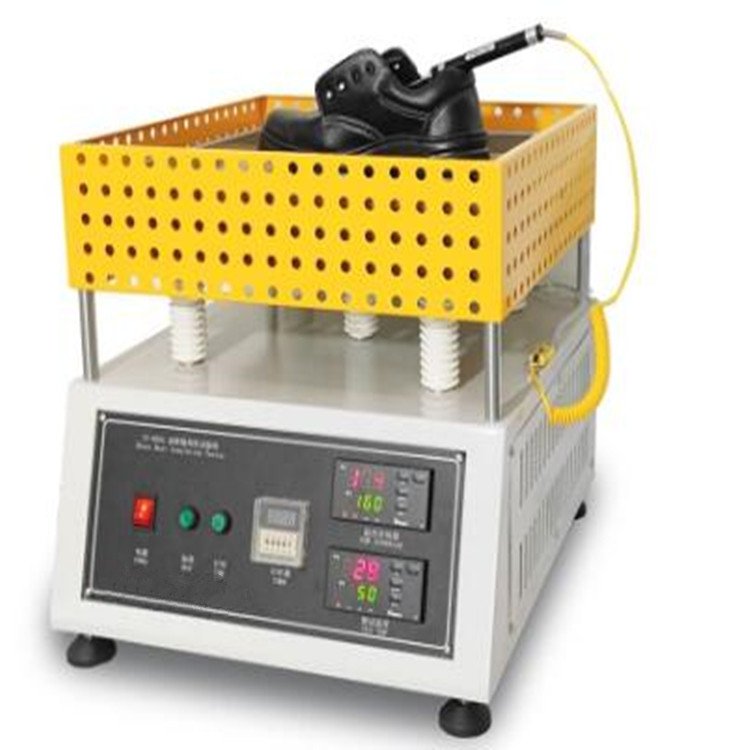
Sole Sand Bath Heat Insulation Tester
Category:Leather Testing Equipment

Introduction
The sand bath component of the Shoe Heat Insulation Tester is primarily used to evaluate the heat insulation or thermal resistance performance of footwear under high-temperature sand and stone thermal media. The following provides a detailed analysis of the main applications and applicable standards for the sand bath in the Shoe Heat Insulation Tester.
Applications
(1)Evaluating Footwear Heat Insulation Performance:
The sand bath simulates extreme high-temperature environments. By placing the test shoe in the sand bath for a specified period, the heat insulation performance of the sole can be evaluated, specifically the temperature rise on the insole surface. This is crucial for ensuring comfort and safety when footwear is used in high-temperature conditions.
(2)Quality Control:
The sand bath section of the Shoe Heat Insulation Tester can be used to verify the manufacturing quality of footwear products, ensuring that products meet design specifications and quality standards. By comparing the heat insulation performance of different production batches or manufacturers, potential quality issues can be detected promptly.
(3)Product Development:
During footwear product development, the sand bath can test how different materials, structures, and designs affect heat insulation performance. This helps designers optimize product design and improve the thermal performance of footwear.
Standards
Testing with the sand bath of the Shoe Heat Insulation Tester should follow relevant industry standards or regulations to ensure accuracy and comparability of results. Common applicable standards include:
(1)EN 12568:
A European standard used to assess footwear heat insulation performance under high-temperature conditions. This standard specifies test methods, equipment, and conditions.
(2)ANSI:
The American National Standards Institute (ANSI) sets various product testing standards. While ANSI standards may not be specifically for footwear heat insulation, some ANSI standards may include requirements related to footwear testing.
(3)JIS:
The Japanese Industrial Standards (JIS), formulated by the Japanese Industrial Standards Committee (JISC), include multiple standards for footwear testing, which may cover heat insulation testing methods.
(4)GB/T 20991-2007:
A Chinese national standard specifying test methods for personal protective footwear. While primarily focused on protective footwear, it may include relevant testing requirements or guidance for heat insulation performance.
(5)Other Relevant Standards:
Other standards may also apply depending on the context, such as CSA (Canadian Standards Association) standards or LD50-1994 (China Labor Protection Equipment Standard). These standards vary according to specific application requirements.
In practice, testers should select appropriate standards based on specific requirements and product characteristics, and follow the prescribed methods and conditions. Additionally, the test equipment should be regularly calibrated and maintained to ensure accuracy and reliability of the results.
Accessories
(1)Sand bath container or tray for even heat distribution.
(2)Thermocouples or temperature probes for accurate measurement.
(3)Sample holders or clamps to secure shoe soles or insulation materials.
(4)Control panel with timer and temperature settings.
Features
(1)Uniform heat distribution for consistent test results.
(2)Accurate temperature control with adjustable settings.
(3)Easy-to-use sample holders for different sole sizes.
(4)Durable construction suitable for repeated testing.
(5)Digital display for real-time temperature monitoring.
(6)Compact design that saves lab space.
(7)Reliable and stable operation for reproducible results.
Maintenance Information
(1)Clean the sand bath and remove residual materials after each test.
(2)Calibrate temperature sensors periodically to ensure accuracy.
(3)Check and tighten electrical connections and heating elements.
(4)Store in a dry, stable environment to prevent corrosion or damage.
FAQ
1. What is the primary purpose of this tester?
It evaluates the heat insulation performance of footwear by simulating high-temperature sand conditions and measuring temperature rise on the insole surface.
2. Which types of footwear can be tested?
The tester is suitable for all types of shoes, including work boots, safety shoes, and everyday footwear requiring heat resistance assessment.
3. How does the testing process work?
Footwear samples are placed in a heated sand bath for a set period. The device measures how well the sole and insole resist heat transfer from the sand to the interior of the shoe.
4. Which standards does this tester comply with?
It can be used according to EN 12568. ANSI, JIS, GB/T 20991-2007. and other applicable national or international footwear heat insulation standards.
5. Who typically uses this equipment?
Footwear manufacturers, quality control laboratories, and R&D teams use it to assess heat insulation performance, ensure product safety, and improve design for thermal comfort
If you're ready to take the next step, Leave your message below and we’ll reply soon. 20+ years of manufacturing & export experience, a partner you can trust.