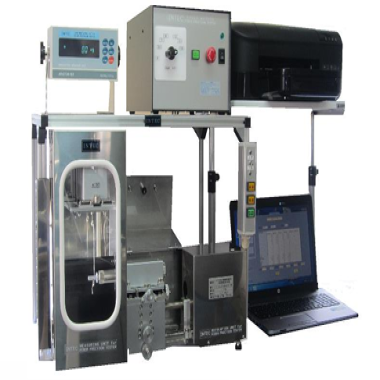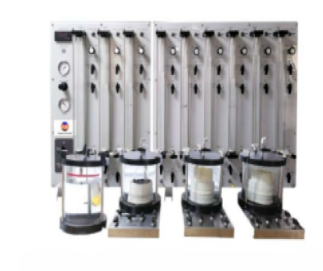
Bentonite waterproof blanket permeability tester
Category:Other
Introduction
Product Introduction
The Bentonite Waterproof Blanket Permeability Tester is designed to determine the permeability coefficient of bentonite waterproof blankets (GCL—Geosynthetic Clay Liners) under specified pressure, hydraulic gradient, and time conditions.
Under controlled confining pressure and hydraulic pressure difference, bentonite produces micro-seepage. By accurately measuring seepage volume and sample thickness over a fixed time, the instrument calculates the permeability coefficient with high precision.
This tester is widely used in geotechnical engineering, environmental protection projects, landfill seepage control, reservoirs, transportation engineering, and quality inspection laboratories.
Compliance Standards
SL/T 235-30-2012 – Test Methods for Geosynthetics
JG/T 193 Appendix A-2006 – Bentonite Waterproof Blanket for Construction Engineering
GB/T 35470 Appendix B-2017 – Geosynthetic Clay Liner (GCL) Test Methods
JC/T 2054 Appendix A-2020 – Bentonite Waterproof Blanket for Waterproofing
ASTM D5887-1999 – Standard Test Method for Measurement of Index Flux Through Saturated Geosynthetic Clay Liners
Instrument Features
The tester is engineered for high accuracy, stable performance, and efficient laboratory operation.
It adopts a 1+2 configuration, allowing a single-station main unit and a dual-station auxiliary unit. A stainless steel workbench ensures durability and corrosion resistance.
The system operates by pressure loading without electricity, improving safety and reliability.
Independent precision valves provide fine control of confining, upstream, and downstream pressures.
High-accuracy readings down to 0.05 mL enhance precision in seepage measurement.
A built-in vacuum device and negative-pressure degassing ensure water entering the sample is fully deaerated, significantly improving test accuracy.
A movable test chamber, simplified valve system, and reserved automatic interface provide flexible operation and easy integration with automated test modules.
Technical Parameters
| Parameter | Specification |
|---|---|
| Sample size | Ø100 mm (customizable), max thickness 50 mm |
| Confining pressure range | 0–600 kPa (87 psi), continuously adjustable |
| End pressure range | 0–550 kPa (79 psi), continuously adjustable |
| Pressure regulation | Independent fine valves for confining, upstream, and downstream; adjustment accuracy 1 kPa (0.1 psi); upstream & downstream can be adjusted simultaneously |
| Pressure display | Switching display for confining / upstream / downstream; accuracy 1 kPa |
| Permeability measurement display | Ruler reading; accuracy 0.05 mL |
| Burette / ring volume | 25 mL / 400 mL |
| Main unit dimensions | 600 × 860 × 180 mm |
| Auxiliary unit dimensions | 900 × 860 × 180 mm |
| Total weight | ~380 kg (Main 180 kg, Auxiliary 200 kg) |
Advantages
High measurement precision for low-permeability materials
No electrical power required for loading—safe and reliable
Stainless steel structure ensures long life and corrosion resistance
Degassing system improves data accuracy
Modular 1+2 design increases test efficiency
Movable test chamber enhances flexibility
Easy-to-operate valve design with fine pressure control
Ready for automation expansion
Product Types
Standard Permeability Tester – for routine laboratory testing
High-Precision Model – equipped with upgraded burette and digital sensors
Automated Permeability Tester – supports real-time pressure capture and automatic seepage calculation
Customized GCL Tester – supports non-standard sample sizes, higher pressure ranges, and special test fixtures
Usage Precautions
Ensure all pipelines and valves are sealed properly before testing
Degas water thoroughly to reduce measurement errors
Gradually apply pressure to avoid sudden impact on the sample
Clean the burette and test chamber after each test to prevent bentonite blockage
Keep the instrument level and avoid vibration during testing
FAQ
1. What types of bentonite waterproof blankets can be tested?
The tester is suitable for all GCL types, including sodium bentonite blankets, polymer-modified GCLs, and composite geosynthetics containing bentonite.
2. Why is degassed water necessary for permeability testing?
Air bubbles trapped inside the sample or test pipeline can alter seepage pathways and result in inaccurate permeability coefficients. Degassed water ensures stable and repeatable measurements.
3. Can this tester measure extremely low permeability coefficients?
Yes. With 0.05 mL reading accuracy and fine pressure control, the instrument can measure very low seepage volumes typical of bentonite liners.
4. How long does a typical test take?
Test duration varies with sample thickness, hydraulic gradient, and seepage rate. Standard tests often require several hours to several days to achieve stable seepage conditions.
5. Is it possible to upgrade the tester for automatic data acquisition?
Yes. The system includes a reserved interface for automatic pressure and volume acquisition. An upgrade module enables full digital data logging and calculation.