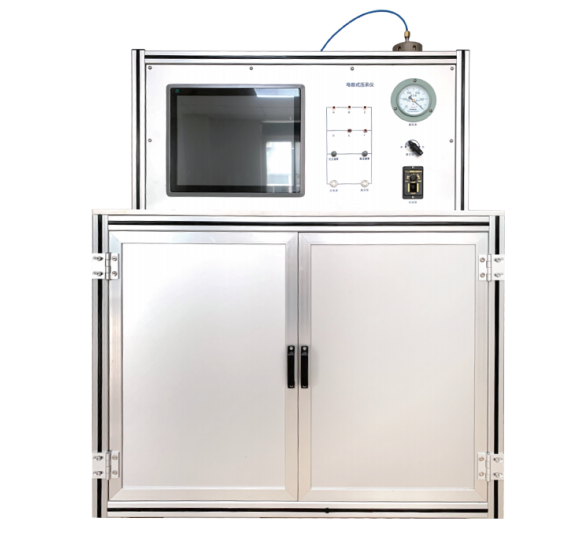
Automatic Mercury Intrusion Pore Size Analyzer
Category:Material Strength Tester
Factory Direct
Stable Performance
Intl. Standards
Tech Support
Fast Delivery
Global Shipping

Introduction
Mercury intrusion porosimetry (MIP) is a widely used method for determining pore volume, pore size distribution, and porosity of solid materials, especially for mesopores and macropores. The method is based on the non-wetting behavior of mercury on most solids. Under external pressure, mercury is forced into the pore structure. The pore characteristics are then calculated based on the Washburn equation.
Pore size measurement range: 30 nm – 200 μm
Pore volume measurement range: 0.3 – 3.5 mL
It is commonly used for shale, catalyst materials, building materials, polymer resins, and other porous materials.
Standards
ISO 15901-1:2005
GB/T 21650.1-2008
Working Principle
Based on the Washburn equation:
r = (-2σcosθ) / p
Where:
r = pore radius (cylindrical model), nm
p = applied pressure (mercury intrusion pressure), MPa
σ = surface tension of mercury, N·m⁻¹
θ = contact angle between mercury and material
The pore radius is inversely proportional to the applied pressure. Higher pressure allows mercury to enter smaller pores. Mercury intrusion follows the sequence: large pores → small pores, external → internal pores. By measuring the mercury intrusion volume at different pressures, the pore volume distribution corresponding to different pore sizes can be obtained, forming the pore size distribution curve.
Technical Specifications
| Item | Specification |
| Pore diameter range | 30 nm – 200 μm |
| Pore volume range | 0.3 – 3.5 mL |
| Accuracy | ≤ 0.5% |
| Analysis station | 1 independent station (sample chamber max 15 cc) |
| Working pressure range | 0.01 – 50 MPa (dual pressure measurement) |
| Maximum pressure | 60 MPa |
| Static pressure head | ≤ 20 mmHg |
| Blank value | ~0.25 mL at 50 MPa |
| Vacuum pump | Dual mechanical pump, ultimate vacuum 0.05 Pa |
| Analysis model | Intrusion/Extrusion curves, cumulative pore volume, surface area, pore size distribution, pore-throat ratio |
| Sample type | Solid particles or bulk solids |
| Safety system | Mercury vapor protection system |
Software Features
The porosimeter software can be integrated with the company’s static volumetric surface area and pore size analyzer (0.35–500 nm range) to achieve full pore size distribution from nano- to micro-scale.
The software interface allows users to control pressure, temperature, and test duration, and records all experimental data, ensuring consistency and repeatability.
Hardware Features
The instrument consists of four main systems: vacuum system, sample chamber system, pressurization system, and measurement & control system. The operation console is connected to a computer system. Mercury-containing vacuum pipelines and sample chambers are installed inside a sealed workflow cabinet.
The operation console and workflow cabinet are separated into mercury-free and mercury-handling areas to ensure operator safety.
Vacuum System
Composed of a dual-stage vacuum pump and vacuum sensor. Ultimate vacuum: 0.05 Pa.
Sample Chamber System
Uses a gravity-difference design. The sample chamber is elevated to create a positive-pressure environment. This ensures pressure measurement is performed under positive pressure conditions, improving accuracy, stability, and safety.
Pressurization System
A 100 mL electric plunger pump provides pressure from 0–50 MPa (7250 psi). Stepless speed control allows precise pressurization and depressurization.
Measurement & Control System
Includes pressure measurement, capacitance measurement, and vacuum measurement systems. Pressure is monitored using dual pressure transmitters (1 MPa and 50 MPa) and digital pressure gauges.
If you're ready to take the next step, Leave your message below and we'll reply soon. 20+ years of manufacturing & export experience, a partner you can trust.