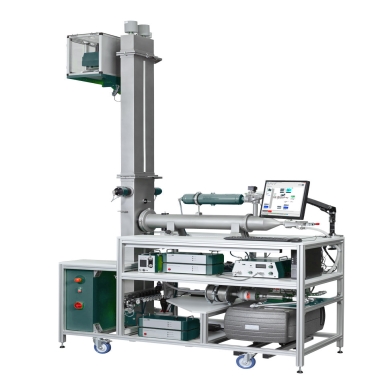
High-efficiency Filter Scanning Testing Machine
Category:Filter Cartridge Filtration Tester
Factory Direct
Stable Performance
Intl. Standards
Tech Support
Fast Delivery
Global Shipping

Introduction
The General Ventilation Test Bench is designed to evaluate the performance of general ventilation air filters. Based on ISO 16890-2016, the system measures filtration efficiency across particle sizes from 0.3 μm to 10 μm, using both oily and saline aerosols. Coarse aerosols (artificial test dust) are employed to determine dust holding capacity and final life efficiency. The test bench ensures accurate classification of air filters according to particulate matter efficiency (ePM).
Application
(1) Testing general ventilation air filters in HVAC systems.
(2) Evaluating filter efficiency across PM1, PM2.5, and PM10 ranges.
(3) Determining filter resistance and airflow characteristics.
(4) Measuring dust holding capacity and end-of-life performance.
(5) Laboratory quality control for filter production and certification.
(6) Research and development of ventilation and filtration products.
Standards
(1) ISO 16890-2016 – Air filters for general ventilation.
(2) Applicable international particulate measurement and testing protocols.
Technical Parameters
| Parameter | Specification |
|---|---|
| Flow Range | 600–5400 m³/h |
| Measurement Error | ±2% or less |
| Resistance Range | 0–500 Pa |
| Accuracy of Measuring Device | 0–70 Pa ≤ ±2 Pa; >70 Pa ≤ ±3% |
| Aerosol Homogeneity | ≤ ±15% |
| Initial Efficiency Repeatability | ±30–40% |
| Particle Concentration Indication Error | 40–60% ≤ ±15%; 60–80% ≤ ±8%; 80–90% ≤ ±4%; 90–99% ≤ ±2% |
| Efficiency Range | ePM1 ≤ 99% (Comprehensive efficiency) |
| Power Consumption | 18 kW |
| Main Pipeline | Square, 610 × 610 mm, 304 stainless steel |
| Floor Area | 13,000 × 2,500 × 2,500 mm (L × W × H) |
| Filtration Efficiency | 1. Filter resistance 2. DEHS counting efficiency (PM1) 3. KCl counting efficiency (PM2.5, PM10) 4. Weighing efficiency |
| Filtration Resistance | Flow-resistance curve |
| Dust Holding Capacity | Final life test of the filter |
| Counter | PALAS Promo2000, sampling flow rate: 5 L/min ±5% |
Features
(1) Key components from imported brands ensure accurate and stable test data.
(2) Pneumatic sealing fixtures allow fast and secure filter installation.
(3) Rotating pipeline structure simplifies filter placement.
(4) Fluid-dynamics-based pipeline design ensures realistic airflow simulation.
(5) Supports testing with both oily and saline aerosols for comprehensive evaluation.
(6) Capable of measuring dust holding capacity and generating flow-resistance curves.
(7) User-friendly interface with real-time data acquisition.
Accessories
(1) Aerosol generators for DEHS and KCl.
(2) Sampling probe and particle counters.
(3) Pneumatic sealing fixtures for different filter sizes.
(4) Flow measurement and pressure sensors.
(5) Data acquisition and printer interface.
Operation and Maintenance
(1) Install the filter securely in the pneumatic fixture.
(2) Configure the aerosol type and concentration according to the test protocol.
(3) Set airflow rate and initialize measurement sensors.
(4) Begin testing: record filtration efficiency, resistance, and dust holding capacity.
(5) Purge the system and clean aerosol generators after testing.
(6) Calibrate particle counters and airflow sensors periodically.
(7) Inspect pipelines and seals for wear or leakage before each test.
(8) Ensure proper ventilation when handling aerosols and follow safety protocols.
If you're ready to take the next step, Leave your message below and we'll reply soon. 20+ years of manufacturing & export experience, a partner you can trust.