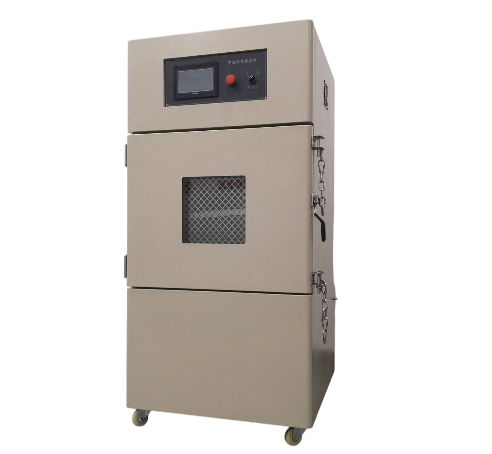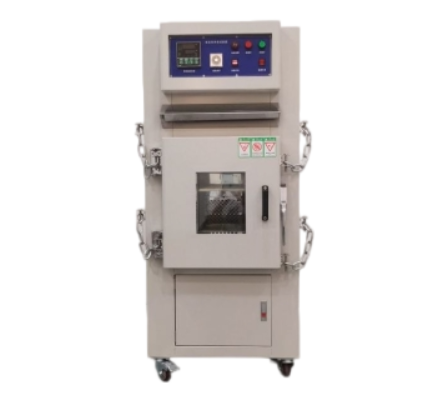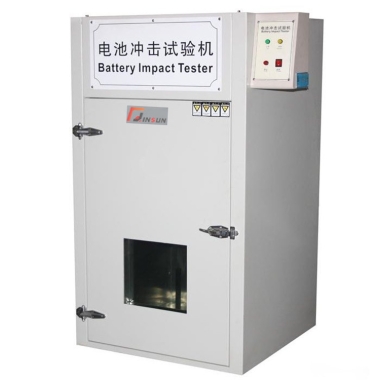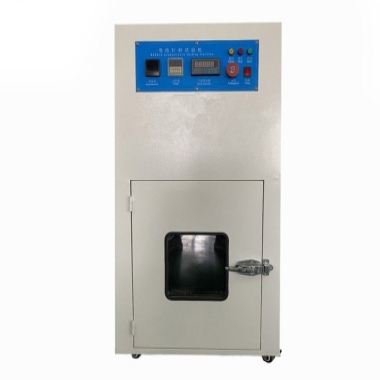
Battery Nail Penetration Tester
Category:Battery Safety Tester
Factory Direct
Stable Performance
Intl. Standards
Tech Support
Fast Delivery
Global Shipping

Introduction
Battery Nail Penetration Tester is designed for evaluating the safety performance of lithium-ion batteries and battery packs under extreme internal short-circuit conditions.
The tester simulates thermal runaway caused by mechanical penetration by driving a rust-free steel nail through the center of the largest surface of the battery at a controlled speed and force. The test is conducted at an ambient temperature of 20 °C ± 5 °C, with temperature monitoring to assess battery reaction such as ignition, explosion or thermal instability.
Application
(1) Consumer Electronics Batteries
Lithium-ion batteries used in smartphones, tablets, laptops, power banks, Bluetooth earphones, smart watches and wearable devices.
(2) Power Tool Batteries
Rechargeable lithium battery packs for electric drills, screwdrivers, garden tools and portable industrial tools.
(3) Electric Vehicle Power Batteries
Cylindrical, prismatic and pouch lithium-ion cells and battery modules used in electric vehicles (EV), electric motorcycles and hybrid electric vehicles (HEV).
(4) Energy Storage Batteries
Lithium battery cells and modules used in residential, commercial and industrial energy storage systems (ESS).
(5) New Energy Battery Systems
Battery packs applied in solar energy storage systems, backup power supplies and communication base stations.
(6) Small Portable Lithium Batteries
Button cells, coin cells and small-capacity lithium batteries used in medical devices, sensors and portable electronic equipment.
(7) Battery Certification & Compliance Testing
Applicable for safety testing in battery manufacturers, third-party laboratories and certification institutions.
Standards
(1) GB/T 18332.2-2001
General Specification for Lithium-Ion Batteries
(2) MT/T 1051-2007
Safety Performance Test Method for Lithium-Ion Batteries Used in Coal Mines
(3) GB/T 31485-2015
Safety Requirements and Test Methods for Power Batteries of Electric Vehicles
(4) GB/T 31241-2014
Safety Requirements for Lithium-Ion Batteries and Battery Packs for Portable Electronic Products
(5) UN 38.3
United Nations Manual of Tests and Criteria – Section 38.3 (Transport of Dangerous Goods)
(6) IEC 62133
Secondary Cells and Batteries Containing Alkaline or Other Non-Acid Electrolytes – Safety Requirements for Portable Applications
(7) UL 1642:2012
Standard for Lithium Batteries
Technical Parameters
| Parameter Category | Specification |
|---|---|
| Nail Diameter | ф2 mm – ф8 mm high-temperature resistant steel needle |
| Penetration Speed | 10 – 40 mm/s |
| Penetration Force | Approx. 2000 kg |
| Stroke | Approx. 200 mm |
| Needle Tip to Base Distance | 250 mm |
| Clamping Distance | 150 mm |
| Driving Mode | Hydraulic drive or motor drive |
| Force Display | Pressure sensing LED display |
| Test Environment | 20 °C ± 5 °C |
| Explosion-Proof Box Size (W × H × D) | Approx. 450 × 750 × 550 mm |
| Explosion-Proof Box Material | Galvanized steel with baked paint finish |
| Machine Dimensions (L × W × H) | Approx. 1640 × 570 × 730 mm |
| Control Box Size (W × H × D) | Approx. 300 × 260 × 170 mm |
| Equipment Weight | Approx. 75 kg |
| Power Supply | Single-phase AC 220 V, 50 Hz |
Accessories
(1) High-temperature resistant steel needles (various diameters).
(2) Temperature measuring thermocouples.
(3) Pressure sensing and display module.
(4) Explosion-proof observation window.
(5) Optional data acquisition and recording system.
FAQ
1. What is the primary purpose of this tester?
It evaluates the safety of batteries by simulating internal short circuits through nail penetration, assessing risks of thermal runaway, fire, or leakage.
2. Which types of batteries can be tested using this device?
The tester is suitable for lithium-ion, nickel-metal hydride, and other rechargeable battery types.
3. How does the tester operate?
A controlled nail is driven into the battery at a specific speed and angle while monitoring voltage, current, temperature, and any abnormal reactions.
4. Which standards does this tester comply with?
It supports international battery safety standards, including UN 38.3. IEC 62133. and UL 2054.
5. Who typically uses this equipment?
Battery manufacturers, quality control laboratories, and R&D teams use it to verify safety, ensure compliance, and improve battery design to withstand internal short circuits.
If you're ready to take the next step, Leave your message below and we'll reply soon. 20+ years of manufacturing & export experience, a partner you can trust.